
ECFMG Certification Guide: Step-by-Step for IMGs
ECFMG certification explained: exam requirements, credential verification, application steps, fees and how it unlocks the US residency Match.
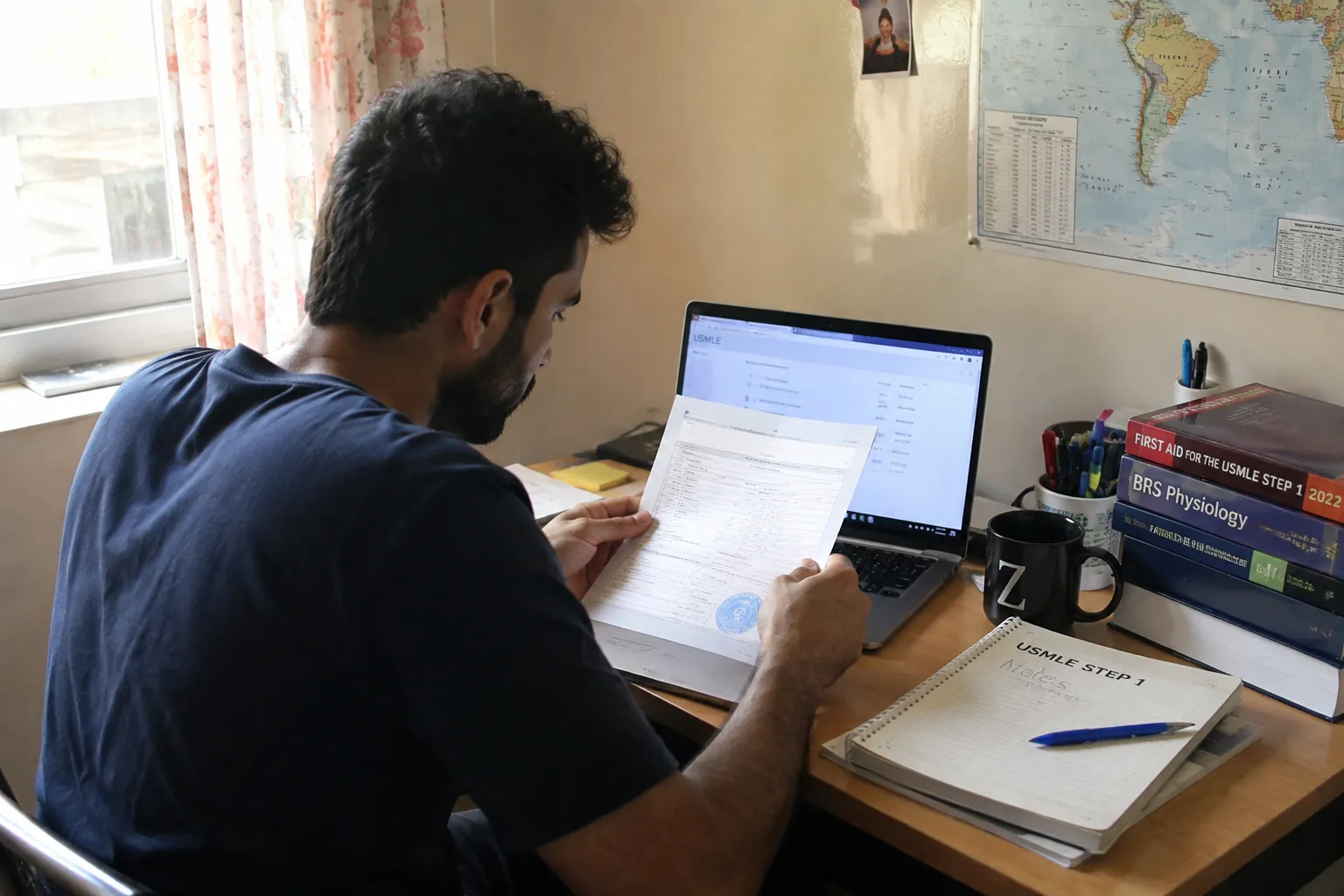
If you graduated from a medical school outside the United States or Canada and you're serious about training or practicing in the U.S., there's one gatekeeper you cannot avoid: ECFMG certification. It's not optional, it's not negotiable, and it's the single credential that stands between you and a spot in the residency Match.
So what is ECFMG certification, exactly? In plain terms, it's a formal verification issued by the Educational Commission for Foreign Medical Graduates confirming that you graduated from an internationally recognized medical school, passed the required USMLE exams, and met specific clinical and communication skills standards. Without it, U.S. residency programs won't review your application, regardless of your grades or clinical experience.
This guide walks through the entire process, from confirming eligibility to understanding what happens after your certificate is issued. We'll also flag the mistakes that trip up otherwise qualified applicants, because the paperwork side of this journey can be just as demanding as the exams themselves.
Quick Answer
ECFMG certification is a credential verifying that an international medical graduate's education, USMLE exam performance, and clinical/communication skills meet U.S. standards for entering residency training. It is required for all IMGs applying to the U.S. residency Match.
In This Guide
- What Is ECFMG Certification, Really?
- Who Qualifies for ECFMG Certification
- Who Doesn't Qualify
- IMG vs. FMG: What's the Difference?
- Common Pathways IMGs Follow
- Step-by-Step ECFMG Application Process
- Challenges Many IMGs Face
- Common Misconceptions
- Frequently Asked Questions
What Is ECFMG Certification, Really?
ECFMG certification exists to give U.S. residency programs, state licensing boards, and hospitals a reliable way to confirm that an international medical graduate's education and credentials are legitimate. Since ECFMG can't personally vouch for every medical school worldwide, it built a rigorous verification system that checks your diploma, transcripts, and exam performance directly against the source institution.
Once you're certified, three things have been confirmed about you:
- You graduated from a medical school listed in the World Directory of Medical Schools and meeting ECFMG's accreditation requirements.
- You passed the required USMLE steps.
- You met the clinical skills and communication skills requirement, typically through an approved ECFMG Pathway.
Think of it less as a single test and more as a full credentialing process, closer to a background check and diploma audit combined. It takes months rather than weeks, which is exactly why so many students underestimate the timeline.
💡 Did You Know?
ECFMG certification was established in 1956 and remains the only pathway recognized by U.S. residency programs for verifying international medical credentials. There is no alternative or "fast-track" certifying body accepted in its place.
Who Qualifies for ECFMG Certification
You're eligible to pursue ECFMG certification if you meet these core conditions.
1. Medical School Eligibility
You need to be a graduate, or in some cases a final-year student, of a medical school listed in the World Directory of Medical Schools and confirmed to meet ECFMG's eligibility requirements. Check this early; not every international medical school qualifies automatically.
2. Accreditation Standard
A policy known as the Recognized Accreditation Policy requires your medical school to be accredited by an agency recognized by the World Federation for Medical Education (WFME). This matters most for students graduating in 2024 or later. If your school lacks WFME-recognized accreditation, certification may not be possible, so confirm this before investing years and tuition into a program.
3. Exam and Skills Requirements
You must pass the required medical science exams (USMLE Step 1 and Step 2 Clinical Knowledge) and satisfy the clinical and communication skills requirement.
⚠️ Common Mistake
Assuming any internationally recognized medical school automatically qualifies. Accreditation status changed materially in recent years, catching some applicants off guard mid-program.
Who Doesn't Qualify
A few groups fall outside the scope of ECFMG certification:
| Group | Certification Needed? | Why |
|---|---|---|
| Graduates of U.S./Canadian LCME-accredited schools | No | Certification exists specifically for international graduates |
| Students at unlisted or non-accredited schools | No (until status changes) | Must meet World Directory and WFME accreditation standards |
| Physicians practicing entirely outside the U.S. system | Not required | Certification is specific to U.S. GME entry |
IMG vs. FMG: What's the Difference?
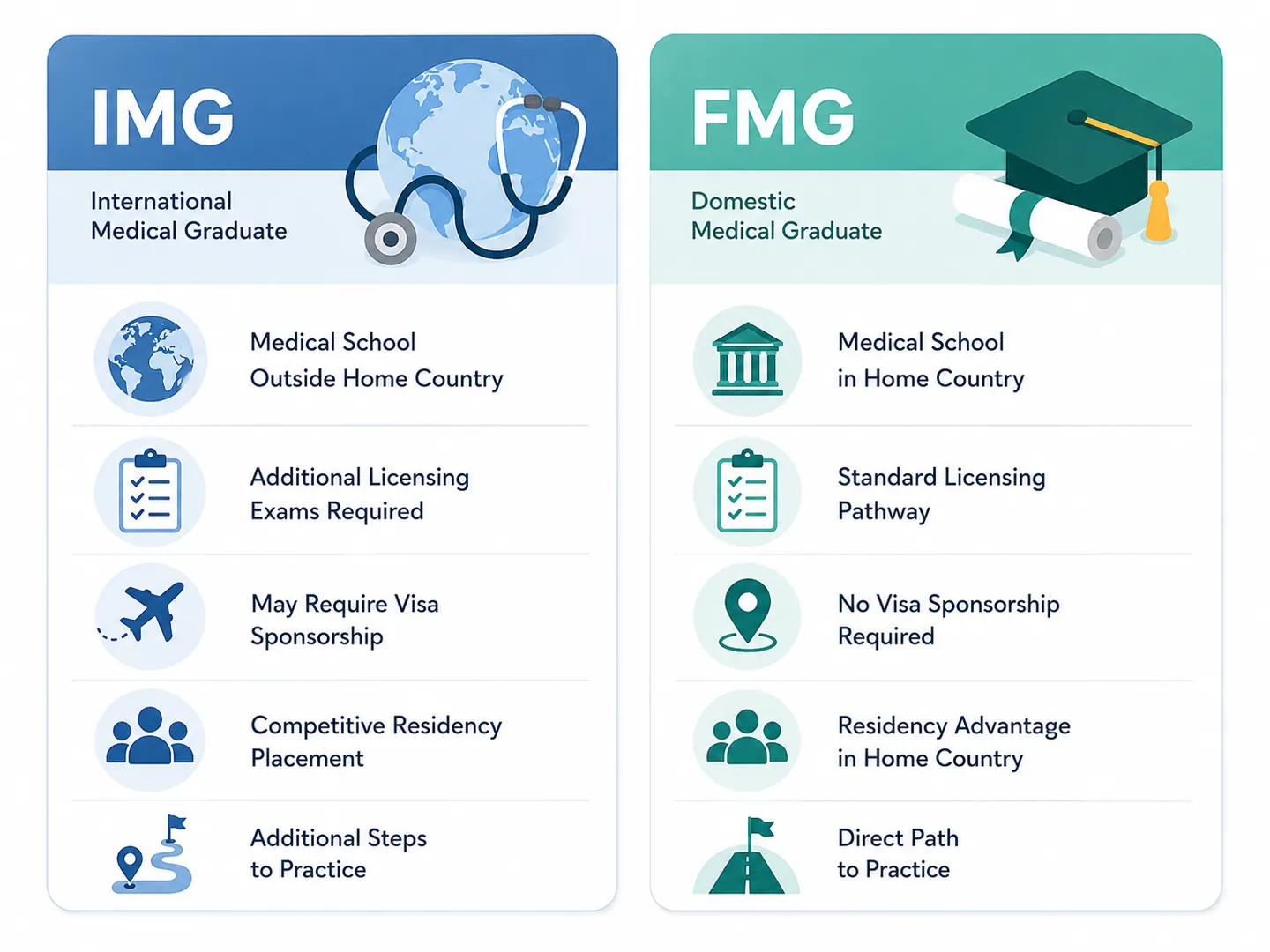
These two terms are often used interchangeably, but they're not identical.
| Term | Definition | Licensing Pathway |
|---|---|---|
| IMG | A physician who graduated from a medical school outside the U.S. or Canada, regardless of citizenship | Requires ECFMG certification for U.S. residency entry |
| FMG | Often used to describe U.S. citizens who attended medical school abroad | Also requires ECFMG certification; sometimes tracked separately in Match statistics |
Featured Snippet
IMG vs. FMG: An IMG is any physician who graduated from a non-U.S./non-Canadian medical school. FMG typically refers specifically to U.S. citizens who studied medicine abroad. Both require ECFMG certification to enter U.S. residency training.
Common Pathways IMGs Follow
There's no single "right" route to ECFMG certification, but most IMGs follow a recognizable pattern.
The Direct Route
Some students complete medical school, pass Step 1 and Step 2 CK relatively close together, complete a Pathway, and apply for certification within a year or two of graduation. This is the fastest route but demands strong early planning, often starting exam prep during clinical rotations.
The Research or Observership Route
Many IMGs, particularly those without U.S. clinical exposure, spend a year or more doing clinical observerships, research fellowships, or externships in the U.S. This builds letters of recommendation and familiarity with the U.S. healthcare system, both of which matter heavily during the residency Match.
The Delayed Route
Some graduates work for a few years in their home country, save money, and pursue certification later. This is completely valid, but it means paying closer attention to time limits on exam validity.
Whichever path you're on, the exam and credentialing requirements stay identical. The real variable is timing and preparation strategy, not the destination.
Step-by-Step ECFMG Application Process
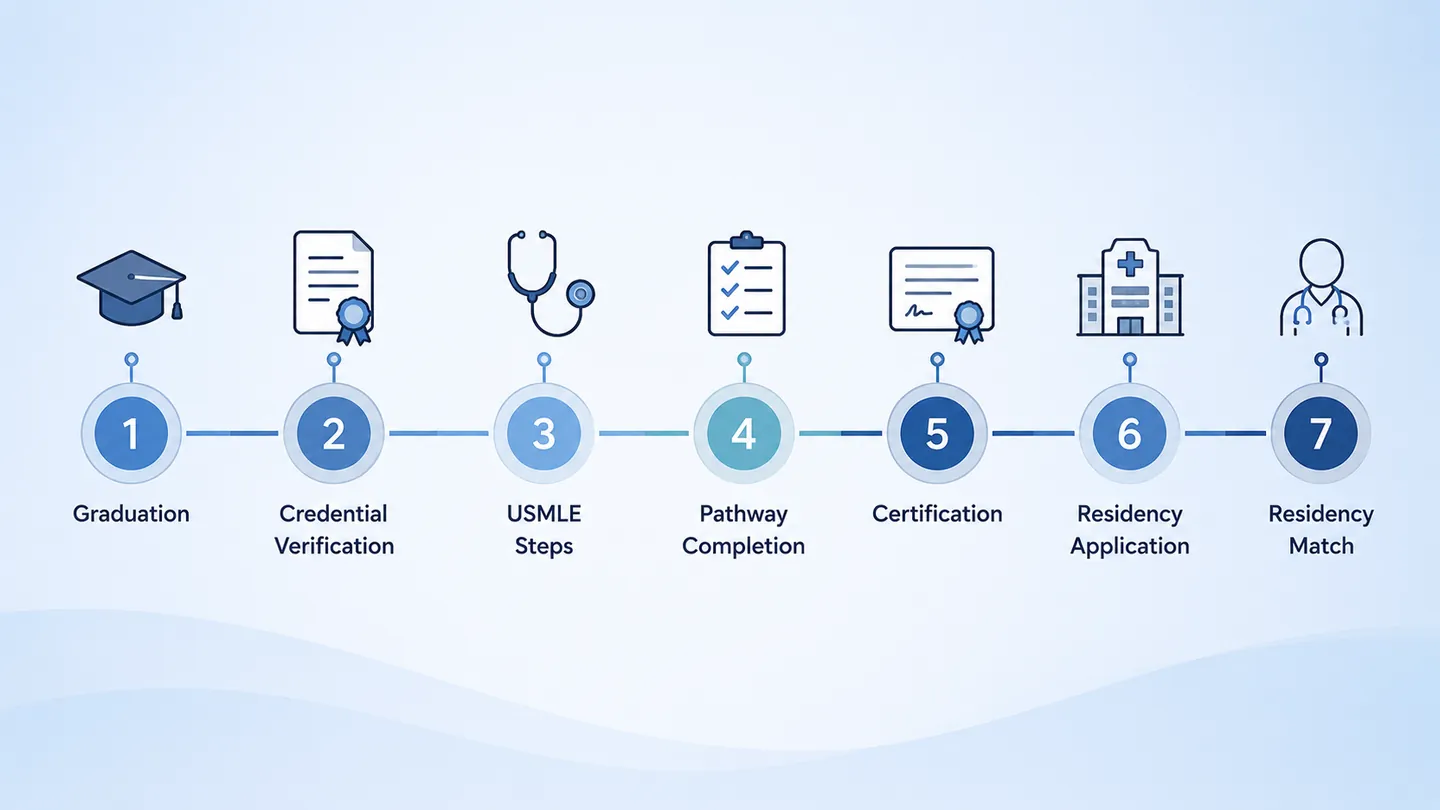
Here's how the process generally unfolds, from first login to certificate in hand.
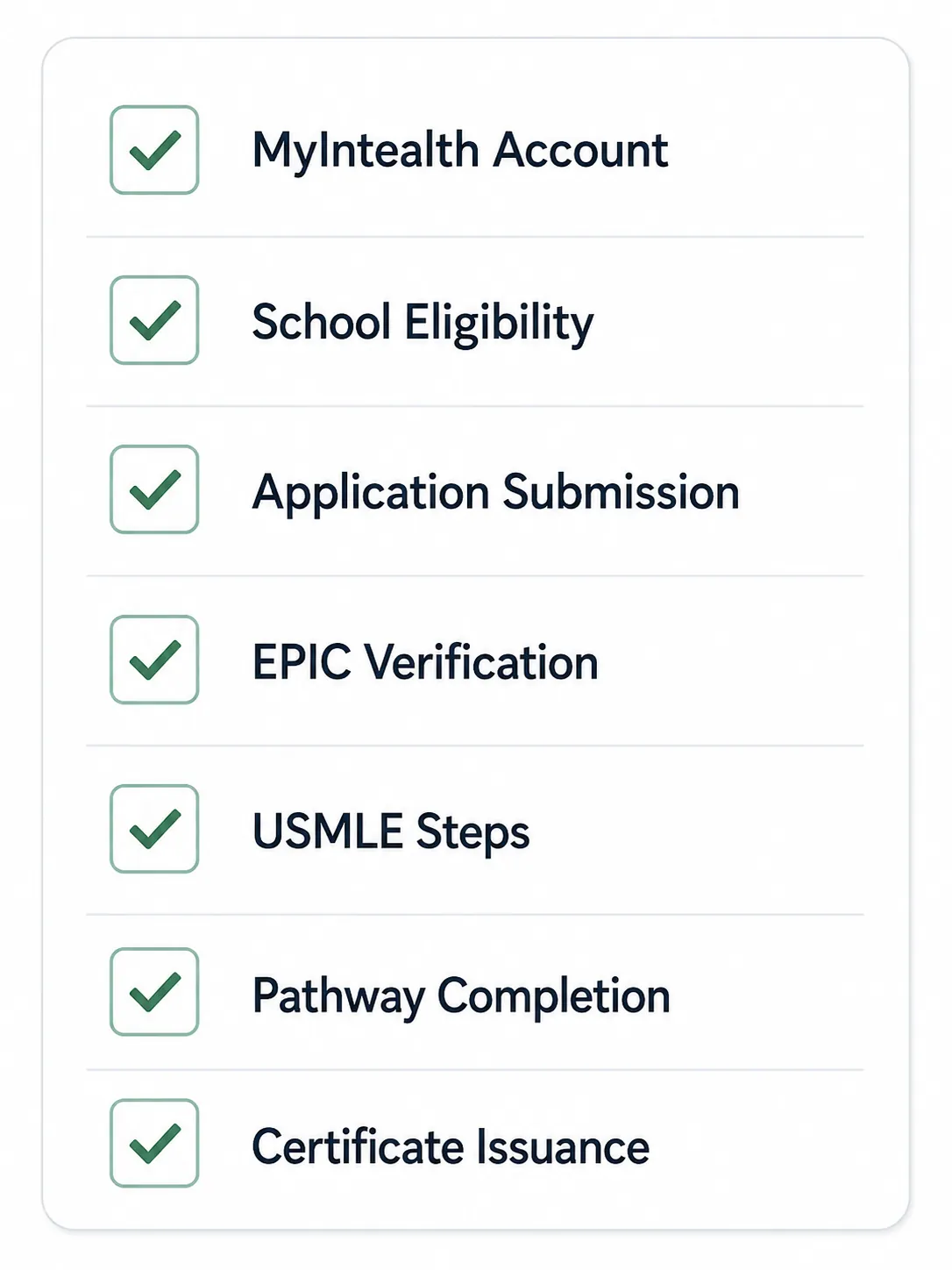
- Create a MyIntealth account. This is the portal through which you'll manage your ECFMG certification application, credential verification, and communication with ECFMG.
- Confirm your medical school's eligibility. Check the World Directory of Medical Schools before spending money on anything else.
- Submit your Application for ECFMG Certification. This confirms your intent to pursue certification and begins collecting your medical education details.
- Begin credential verification through EPIC. This is often the longest part of the process; most credentials are verified within 30 to 90 days, but school-side delays are common, so start early.
- Register for and pass USMLE Step 1 and Step 2 CK. Exam registration for IMGs is now handled through the Federation of State Medical Boards (FSMB), so track which portal handles which task.
- Satisfy the clinical and communication skills requirement. This is done through an ECFMG Pathway, including a qualifying score on the OET Medicine exam. Pathways run on seasonal cycles, so timing matters.
- Wait for ECFMG to confirm all requirements are met. ECFMG issues your Standard ECFMG Certificate, typically within a few weeks of full verification.
- Use your certification to register for the Match. With certificate in hand, you can proceed with ERAS applications and the residency Match process.
⚠️ Warning
Missing a Pathway application deadline can delay your entire Match timeline by a full year, since Pathways operate on fixed seasonal cycles rather than rolling admission.
Challenges Many IMGs Face
- Document delays. Medical schools abroad don't always respond quickly to verification requests, and some charge processing fees. This is often the single biggest bottleneck in the timeline.
- Exam sequencing mistakes. Some students take Step 1 too early, before they're ready, and struggle to recover momentum after a low score.
- Underestimating clinical experience needs. Competitive U.S. residency programs value U.S. clinical experience highly.
- Financial strain. Application fees, credential verification charges, Pathway costs, exam fees, and travel expenses add up quickly.
- Navigating two separate systems. Exam registration runs through FSMB while certification stays with ECFMG. A missed deadline in one can stall progress in the other.
Real-World Scenario
An IMG who passed both USMLE steps on the first attempt still delayed their Match year by 12 months because their medical school took four months to respond to an EPIC verification request. Starting credential verification the day you decide to pursue U.S. training, not after passing your exams, avoids this exact situation.
Common Misconceptions About ECFMG Certification
"Passing the USMLE is enough."
Not true. Passing Step 1 and Step 2 CK is necessary but not sufficient. You also need the clinical and communication skills requirement satisfied through a Pathway, plus full credential verification.
"ECFMG certification guarantees a residency spot."
It doesn't. Certification is a prerequisite to enter the Match, not a guarantee of matching. Exam scores, clinical experience, letters of recommendation, and interview performance still determine competitiveness.
"Once certified, you're certified forever."
This depends on how you met the clinical and communication skills requirement. Certificates based on Pathways carry expiration dates unless you complete a required period of ACGME-accredited clinical training afterward.
"Any medical school abroad qualifies."
Accreditation status matters significantly now, especially with the Recognized Accreditation Policy affecting recent graduates. Verify this before enrolling in a program, not after graduating from it.
Key Takeaways
- ECFMG certification verifies your medical school credentials, USMLE performance, and clinical/communication skills, and it's mandatory for IMGs entering U.S. residency training.
- Eligibility depends heavily on your medical school's accreditation status; confirm this early through the World Directory of Medical Schools.
- The process spans multiple systems: MyIntealth and EPIC for credentialing, FSMB for USMLE exam registration.
- Credential verification delays are usually the biggest bottleneck, so start that process as early as possible.
- Certification is a requirement to enter the Match, not a guarantee of matching.
- Some certificates expire, depending on the pathway used to satisfy clinical and communication skills requirements.
Frequently Asked Questions
How long does ECFMG certification take?
Timelines vary, but most IMGs should expect the full process, from initial application to final certificate, to take anywhere from several months to over a year, largely depending on how quickly your medical school responds to credential verification requests.
What are the ECFMG certification steps in order?
Create your MyIntealth account, confirm your school's eligibility, submit your application, begin credential verification through EPIC, pass Step 1 and Step 2 CK, complete a Pathway (including OET Medicine), and wait for certificate issuance.
Do I need a Pathway if I already passed Step 2 CS before it was discontinued?
No. A valid passing performance on the former Step 2 Clinical Skills exam satisfies the clinical and communication skills requirement directly, without needing a Pathway.
How much does ECFMG certification cost?
Costs include the certification application fee, EPIC credential verification fees, USMLE exam fees, and Pathway application fees, historically running into the hundreds to low thousands of dollars combined. Fees change periodically, so check ecfmg.org directly before budgeting.
Can I start the ECFMG application before graduating?
In many cases, yes. Final-year students at eligible medical schools can often begin parts of the process, such as creating an account and starting credential collection, before official graduation, though full certification requires proof of graduation.
What happens if my medical school isn't accredited by a WFME-recognized body?
You may not be eligible for ECFMG certification, particularly for 2026 and later graduates. Investigate this as early as possible, ideally before enrolling in a medical program abroad.
Is ECFMG certification the same as a medical license?
No. ECFMG certification is a prerequisite for entering U.S. graduate medical training. Your actual medical license is issued later by an individual state medical board after completing residency and meeting that state's requirements.
Does ECFMG certification expire?
It can, depending on how you satisfied the clinical and communication skills requirement. Pathway-based certificates typically carry expiration dates unless you complete a required period of ACGME-accredited clinical training.
Conclusion
ECFMG certification is rarely the hardest intellectual challenge in the IMG journey, USMLE prep usually claims that title, but it is often the most logistically demanding. Between credential verification, Pathway timing, and exam scheduling across two separate systems, staying organized matters just as much as staying academically prepared.
The IMGs who move through this process most smoothly tend to do a few things consistently: they check their medical school's eligibility before assuming anything, they start credential verification months before they think they need to, and they treat exam prep as a marathon rather than a sprint squeezed between clinical duties.
Next Step
Get the ECFMG document checklist
Download the free ECFMG document checklist and join the Sentia Telegram community, where thousands of IMGs share timelines, verification updates, and study strategies in real time. Sentia's question banks, offline-first study tools, and learning analytics were built for exactly this kind of long, multi-stage prep.