
Nigerian Doctors relocate to Canada: Complete 2026 Guide
How Nigerian doctors relocate to Canada: MCCQE, NAC OSCE, credentialing, residency and licensing pathways, with timelines and costs.

This guide covers the full Nigerian doctor to Canada pathway, step by step. Every year, hundreds of Nigerian-trained doctors start this journey. Most underestimate how structured it is. They also underestimate how long it takes.
Canada doesn't assess you on reputation or years of experience alone. Every international medical graduate (IMG) follows the same path. That means the same national exams, the same credential checks, and one of two clearly defined routes into practice.
This guide walks through that pathway in order. It covers what to verify first and which exams to take. It compares the residency match with the Practice-Ready Assessment route. It also covers the process costs and how long each stage realistically takes.
How Nigerian Doctors Relocate to Canada: Two Official Routes
Nigerian doctors already know the UK's PLAB route well. Many also know the US's ECFMG/USMLE route. Canada runs on a different body entirely: the Medical Council of Canada (MCC). The MCC sets and administers the national exams that every IMG must pass. Only then can you be considered for residency or licensure.
Canada also splits into two life pathways, not one. Picking the right one early saves years. Most guides refer to this as the IMG Canada pathway. Both routes lead to the same place: the right to practice medicine in Canada. Here's how each one works:
- Route A: CaRMS residency match. Pass the MCC exams. Then compete for a residency spot through the Canadian Resident Matching Service (CaRMS).
- Route B: Practice-Ready Assessment (PRA). Built for doctors who've already completed postgraduate training and worked independently abroad. This fits many Nigerian IMGs: those who've completed NYSC, residency, or years of practice at home. Instead of a full Canadian residency, PRA uses a supervised clinical assessment. It's typically in family medicine.
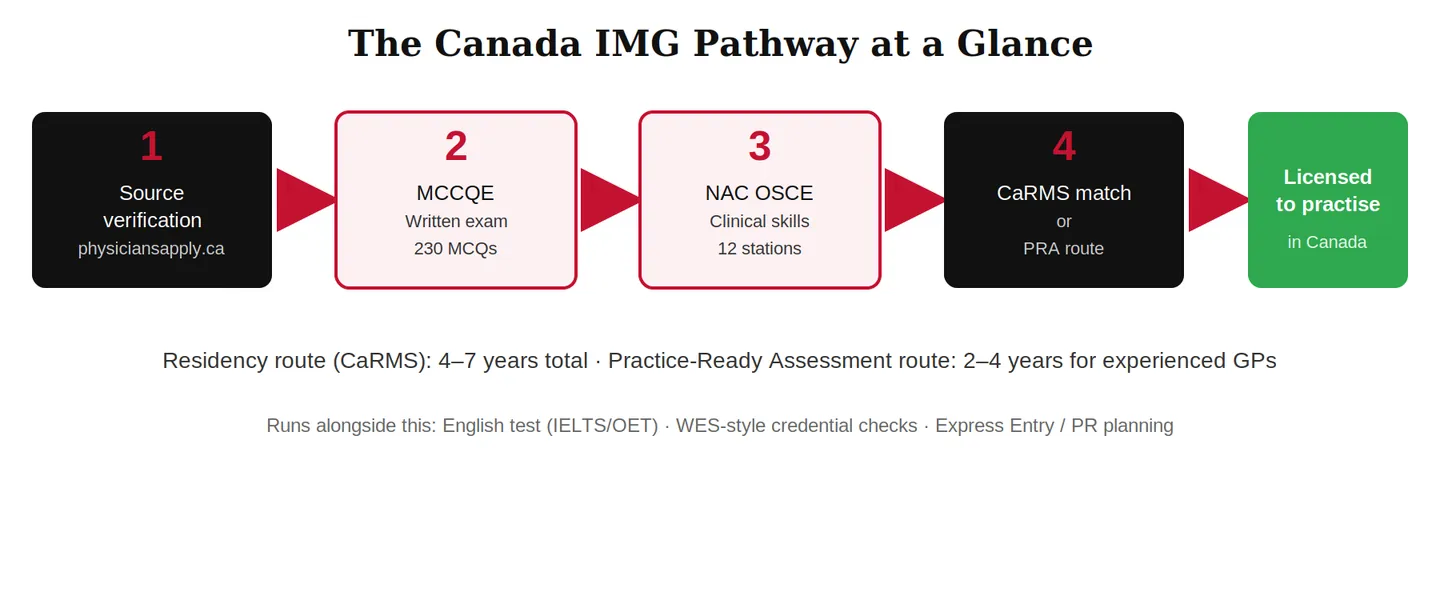
CaRMS vs PRA at a glance
| Route | Best suited to | What it leads to |
|---|---|---|
| CaRMS residency match | Earlier-career doctors; specialties outside family medicine | Full Canadian residency (2-5 years), then licensure |
| Practice-Ready Assessment | Doctors with completed postgraduate training and independent practice | 12-week supervised assessment, then provisional license tied to return of service |
Whichever route you pick, the process to relocate to Canada starts the same way with source verification.
Documents to gather before you start
Most delays for doctors trying to relocate to Canada come from paperwork. Usually, the paperwork comes first and could have been sorted in Nigeria before the process even began.
Before you create your physiciansapply.ca account, have these ready, or at least requested:
- MBBS certificate and full academic transcript from your medical school.
- NYSC discharge or exemption certificate.
- MDCN certificate of registration and a letter confirming good standing.
- Reference letters from supervising consultants, if you've worked at more than one facility.
Having these organized speeds up every step that follows. That includes your CaRMS or PRA application, your provincial registration, and later, your immigration file.
Step 1: Source verification through physiciansapply.ca
Before you can register for any MCC exam, your Nigerian medical degree needs to be source-verified. This happens through your physiciansapply.ca account. It's the single portal you'll use for almost everything that follows.
The MCC contacts your medical school directly to confirm your degree. This step depends on how quickly your school's records office responds. Build in extra time here. It's one of the most common places Nigerian doctors lose months, waiting on university administration.
Ontario works differently, though. Source verification for that province runs through the College of Physicians and Surgeons of Ontario, not the standard MCC process. Confirm this early if Ontario is your target.
With verification underway, here's what MCCQE and NAC OSCE for Nigerian doctors actually involve.
Step 2: The MCCQE
The MCC Qualifying Examination was recently renamed from "MCCQE Part I" to simply "MCCQE." It's a one-day, computer-based test with 230 multiple-choice questions. It's split into two 160-minute sections, with an optional break between them.
It's delivered at Prometric centers in over 70 countries. Some are accessible from Nigeria, so you don't need to travel to Canada to take them. The exam runs four times a year, on a first-come, first-served basis. The application fee currently sits around CAD $1,470.
You can sit the MCCQE and the NAC exam in either order. Most candidates prepare for the MCCQE first, though. It builds knowledge you'll draw on for the clinical exam, too.
Step 3: The NAC Examination (clinical skills)
The National Assessment Collaboration (NAC) Examination is Canada's version of PLAB 2, or the OET clinical stations. It's a hands-on OSCE built for IMGs. It runs about 12 stations. Each one is a clinical scene with a standardized patient.
Unlike the MCCQE, the NAC is only offered in person. It runs at select Canadian centers twice a year. This is usually the step that requires a trip to Canada. Budget around CAD $3,000 for the exam fee. A resit costs the same again, so first-attempt preparation pays for itself.
One thing catches Nigerian doctors off guard. The NAC weighs communication style and patient-centered language more heavily than many international OSCEs do. If you trained in a more directive consultation style, practice adjusting it before the exam. Don't just prepare the clinical content.
How Nigerian doctors can move to Canada as a doctor via CaRMS
CaRMS is your route if you're earlier in your career. It's also the route if you're targeting a specialty beyond family medicine. It's a centralized, algorithm-based match. It places candidates into residency programs each spring.
It is a real fight for IMGs. Canadian medical graduates go first in round one. IMG match rates run well below those of domestic graduates. Several things improve your odds, though:
- Strong MCCQE and NAC scores.
- Canadian clinical exposure, such as observerships or electives.
- A well-crafted personal statement.
- A broad, well-planned application list that includes family medicine and rural postings.
Together, these give you a real shot at matching, even in a competitive pool. A residency itself runs two to five years, depending on the specialty. Provincial registration and full licensure follow.
For the exam requirements, CaRMS applies to each province; see the NAC OSCE guide and the CaRMS IMG match guide.
The Practice-Ready Assessment route
PRA suits doctors who've already finished postgraduate training. It also suits those who've practiced independently outside Canada. In practice, this is often the stronger fit for Nigerian doctors, those with completed residency training or several years of independent practice.
Nine provinces currently run PRA programs, most commonly in family medicine. After passing the MCCQE and NAC, candidates undergo a supervised clinical placement. It typically runs 12 weeks. Trained Canadian physicians assess you throughout.
Pass, and you receive a provisional license. It's usually tied to a return-of-service commitment of two to three years in a community that needs physicians. Most PRA graduates hold a full, unrestricted license within two years of completing the assessment.
Each province's eligibility bar differs. British Columbia and Saskatchewan, for example, require several years of recent independent practice. Ontario, meanwhile, runs its IMG pathway through the College of Physicians and Surgeons of Ontario instead. Confirm the specific requirements for your target province before applying.
Language proficiency
Every practicing physician in Canada must demonstrate proficiency in English or French. For Nigerian doctors, this usually means IELTS or OET. The score threshold is set by your target province and program, not by the MCC itself.
Take the language test early. Many candidates take it before the MCC exams, partly to get it out of the way early. A valid score is also often required just to complete your CaRMS or PRA application.
What it costs to relocate to Canada as a doctor
The Canadian IMG pathway isn't cheap. The costs are spread across nearly every stage. Here's what Nigerian doctors typically budget from source verification through a completed CaRMS application cycle. This is before relocation or living costs.
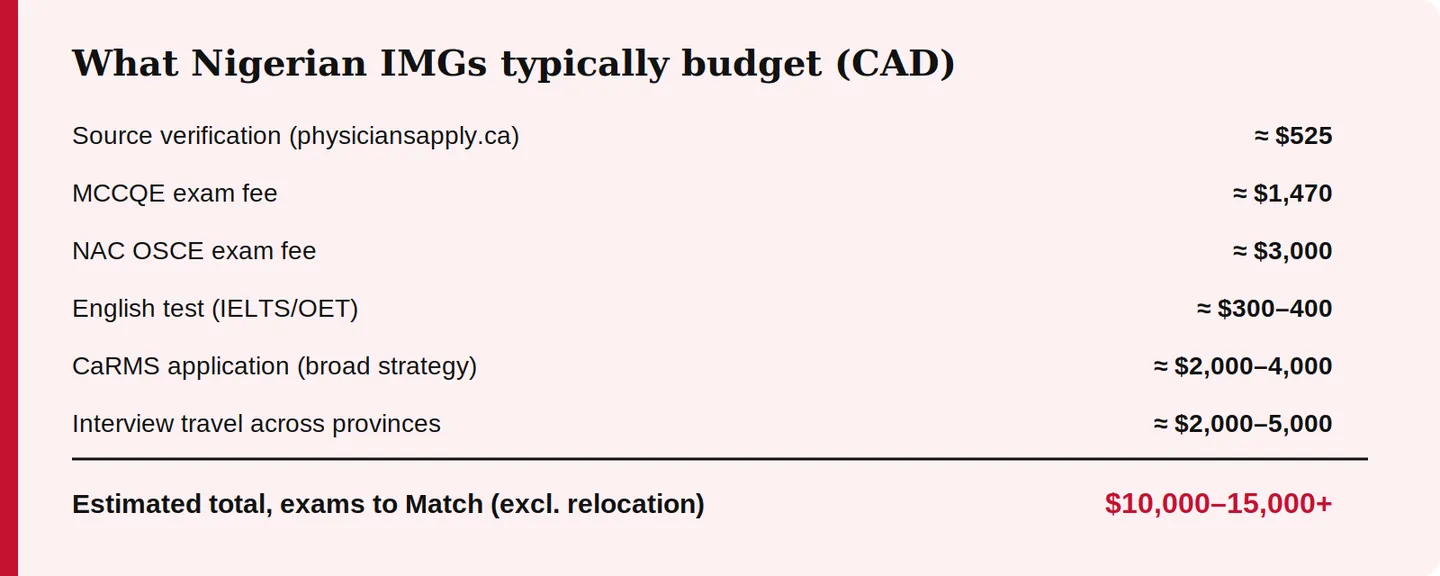
For a fuller breakdown covering flights, visa fees, and settling-in costs once you land, see the cost of relocating abroad as a Nigerian doctor.
How long does it take to relocate to Canada as a doctor?
Plan in years, not months. A realistic sequence:
- Language testing: 3-6 months (can run alongside other steps).
- Source verification: 2-4 months.
- MCCQE preparation and sitting: 6-12 months.
- NAC OSCE preparation and sitting: 3-6 months.
- CaRMS or PRA application and placement: 6-12 months.
- Residency (2-5 years) or PRA return-of-service (2-3 years).
End to end, most Nigerian doctors are looking at four to seven years via CaRMS. PRA can bring that down to two to four years for those who already qualify.
Immigration: getting permanent status sorted alongside the medical pathway
Passing Canada's medical exams doesn't by itself grant you the right to live and work there. The licensing pathway and the immigration pathway run in parallel, not one after the other.
Physicians commonly move through one of three routes:
- Express Entry at various points; this has included family medicine and specialist physicians on in-demand occupation lists.
- A Provincial Nominee Program tied to the province where they'll practice.
- Employer-sponsored routes tied to a confirmed residency or PRA placement.
PR processing timelines and provincial nomination criteria shift from year to year. It's worth starting this conversation early. Speak with a licensed Canadian immigration consultant or lawyer as soon as your MCC exam plan is set, not after you've matched.
Where Nigerian doctors typically lose time
- Waiting on the medical school for source verification. Start this the moment you decide Canada is the plan.
- Sitting with the NAC without adjusting communication style. Strong clinical knowledge alone doesn't guarantee a strong NAC score.
- Applying to CaRMS too narrowly. A wider spread across programs and provinces tends to improve your IMG match odds.
- Treating PRA and CaRMS as interchangeable. Decide which one fits your training and experience before investing in exam prep.
- Leaving immigration planning until after the match. Run it alongside your exam timeline, not after it.
Frequently asked questions
Can a Nigerian-trained doctor practice in Canada without repeating a residency?
Yes, if you qualify for the Practice-Ready Assessment. This route is for doctors who have already finished postgraduate training and practiced on their own. It swaps a full Canadian residency for a supervised clinical assessment instead.
Do I need to take the MCCQE and NAC in a set order?
No. The Medical Council of Canada lets you sit for either exam first.
Can I sit the MCCQE while still in Nigeria?
Yes. The MCCQE runs at Prometric test centers in over 70 countries. The NAC exam, however, must be taken in person at a Canadian test center.
Is the CaRMS match realistic for IMGs, or should I focus on PRA?
Both are realistic, but they suit different people. CaRMS fits earlier-career doctors, or those aiming for a specialty outside family medicine. PRA fits doctors who have already finished training and worked on their own.
How much English proficiency do I need if I trained and worked in English in Nigeria?
You still need to take the IELTS or OET. You still need to hit the score your target province sets. There's no exemption for English-language training.
Does passing the MCC exams guarantee permanent residency?
No. Licensing and immigration are two separate tracks that run side by side. Passing your exams helps your immigration case. But it doesn't grant PR on its own.
Which province should a Nigerian doctor target first?
It depends on your specialty, your PRA eligibility, and the current demand. Saskatchewan, Manitoba, and British Columbia have long run more open PRA programs for family doctors. Ontario, by contrast, tends to be more competitive for CaRMS-matched specialty spots. Check each province's current rules before you commit.
Key takeaways: how Nigerian doctors relocate to Canada
- Every route starts the same way: source verification, then the MCCQE, then the NAC examination.
- From there, choose between CaRMS (residency match) and Practice-Ready Assessment (accelerated route for experienced doctors).
- Budget CAD $10,000-15,000+ for exams and applications alone, before relocation costs.
- Realistic timelines run four to seven years via CaRMS, or two to four years via PRA.
- Run immigration planning alongside your exam and application timeline, not after it.
- Whether you go to CaRMS or PRA, plan to relocate to Canada in stages, not in one leap.
For exam-by-exam detail, see the MCCQE Part 1 guide, the NAC OSCE guide, and the CaRMS IMG guide.
Planning your own relocation to Canada?
Get the free Canada IMG roadmap and ask questions in the Sentia Telegram community.
Sources: Medical Council of Canada (mcc.ca) · CaRMS (carms.ca). Licensing and immigration requirements change: always confirm current details with the MCC, CaRMS, and your target province's medical regulatory authority before making decisions.