Practice Medicine in Canada: 2026 Guide for IMGs
Step-by-step guide for International Medical Graduates (IMGs) to practice in Canada in 2026. Covers exams, residency, provincial requirements, and licensing…
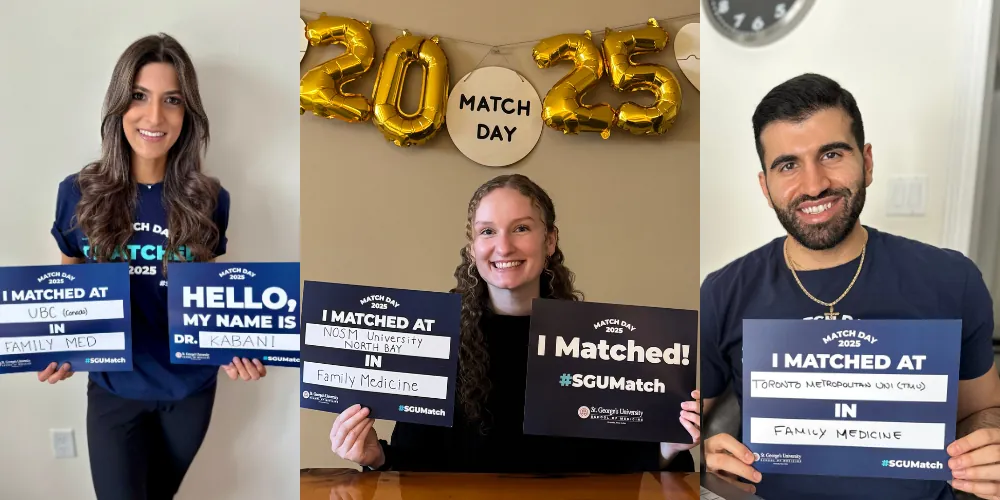
If you’re an international medical graduate thinking about coming to Canada, you’ve probably realized something very quickly. It’s not a simple process, and most of the information out there is either incomplete or confusing. Over the past few years at McGill, I’ve had countless conversations with IMGs at different stages of this journey. Some are just starting, some have been trying for years, and some have successfully made it through. And what I’ve noticed is that the difficulty isn’t just the competition. It’s the lack of clarity. This guide is meant to fix that.
I’m going to walk you through the entire process, from your first step with PhysiciansApply all the way to residency and licensing, in a way that actually makes sense. The goal is not just to tell you what to do, but to help you understand how to approach the system strategically.
Understanding the IMG Pathway in Canada
One of the first things that confuses people is that there is no single “application” to become a doctor in Canada. Instead, you move through a series of steps that are all connected but managed by different organizations.
In most cases, the path looks like this:
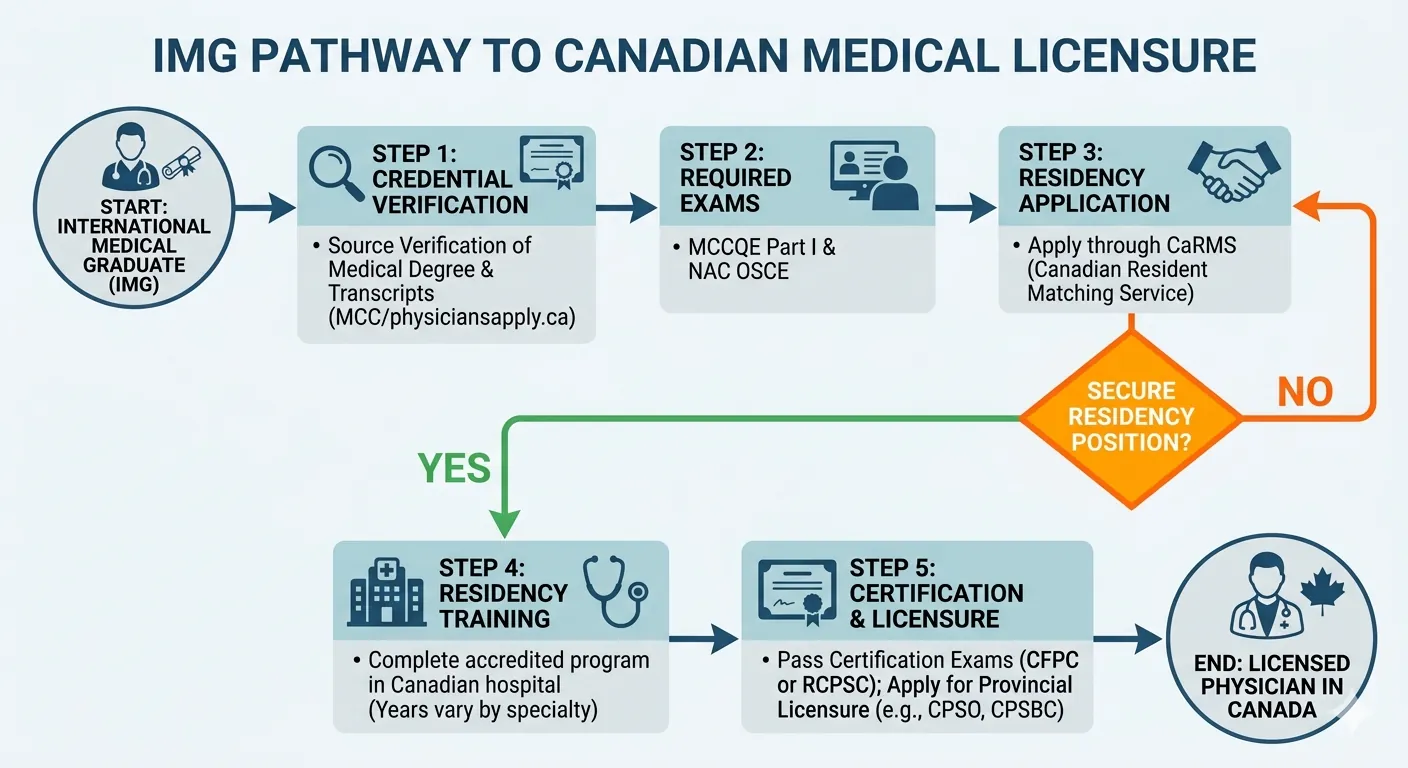
- Get your credentials verified
- Pass Canadian licensing exams
- Apply for residency through CaRMS
- Complete residency in Canada
- Obtain provincial licensure
There are exceptions, especially for experienced physicians, but for most IMGs this is the standard route.
Step 1. PhysiciansApply: Verifying Your Medical Degree
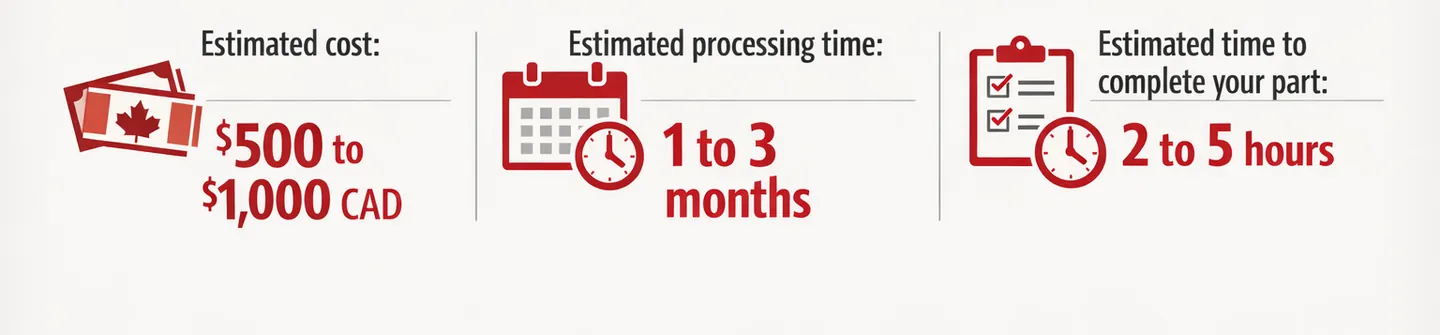
Estimated cost: $500 to $1000 CAD
Estimated processing time: 1 to 3 months
Estimated time to complete your part: 2 to 5 hours
What PhysiciansApply actually is
PhysiciansApply is the official platform run by the Medical Council of Canada where you:
- create your account
- upload your credentials
- verify your medical degree directly with your university
One of the most common early mistakes I see is underestimating this step. I’ve seen candidates who were ready to write exams and apply, only to realize their documents were still being processed. That delay alone cost them an entire year.
And until you're done:
- You can’t register for MCC exams
- You can’t apply to CaRMS
- You’re NOT fully in the system
It’s administrative, but it sets the timeline for everything else.
What it actually costs
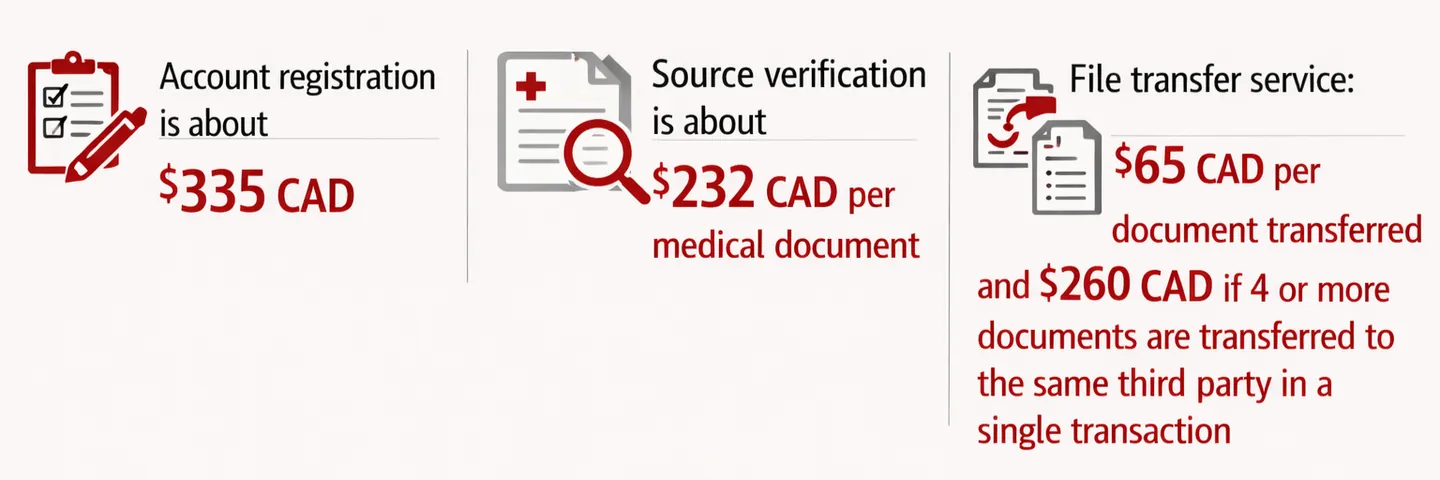
Most IMGs underestimate how quickly costs start adding up here.
There are three main components:
- Account registration is about $335 CAD
- Source verification is about $232 CAD per medical document
- File transfer service: $65 CADper document transferred and $260 CAD if 4 or more documents are transferred to the same third party in a single transaction
NB: Take note that all of the above fees are NON-REFUNDABLE
In practice, most applicants submit at least a diploma and a transcript. That brings the total to roughly $500 to $1000 CAD at this stage alone. And this is before you register for any exams.
Step 2. MCCQE Part I: Your Most Important Exam
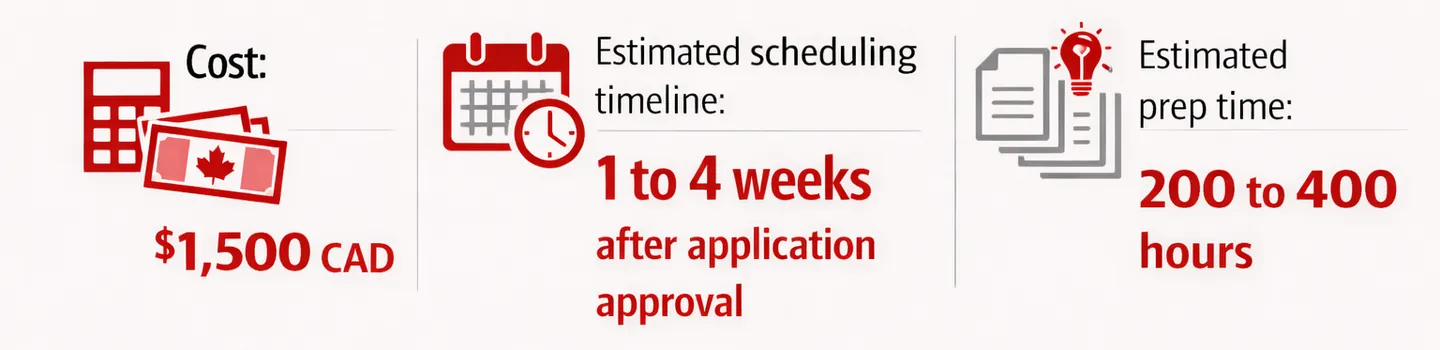
Cost: $1,500 CAD
Estimated scheduling timeline: 1 to 4 weeks after application approval
Estimated prep time: 200 to 400 hours
When I ask IMGs who matched what mattered most in their application, this exam comes up almost every time.
The MCCQE Part I is more than a requirement. It’s one of the only standardized ways programs can compare IMG candidates.
A strong score signals that you can function within the Canadian medical framework. A weak score, even if you pass, can quietly limit your opportunities.
This is not an exam you rush. It’s one you prepare for properly, because it shapes how your entire application is perceived.
What it actually costs
The registration fee for the MCCQE Part I is $1,500 CAD.
If you need to reschedule your exam, the fee depends on how early you make the change. Changes made more than 30 days before your exam cost $50 CAD, while changes made closer to the exam can increase up to $600 CAD. For intance, extending the eligibility window will encur a fee of $120 CAD and the policy states that if the exam fee has increased between the time that you applied and the extension of your eligibility window, you will be required to pay the difference between the two.
If you cancel your exam, you may receive a partial refund depending on the timing, but a $750 CAD withdrawal fee is always retained.
In the instance where you are not satisfied with your score and believe it may have been an internal mistake, a fee of $1200 CAD will be charged to appeal the results.
Beyond the registration fee, many candidates also invest in preparation resources. While not mandatory, these are commonly used and can add additional costs depending on what you choose.
How long it actually takes
Once your application is accepted, it typically takes 1 to 4 weeks to receive your eligibility and schedule your exam, depending on availability at your selected testing center.
Preparation time varies, but most IMGs spend several months studying. In practice, this often translates to a few hundred hours of focused preparation, especially if you are adapting to the Canadian exam style.
Step 3. NAC OSCE: Adapting to the Canadian Clinical Style
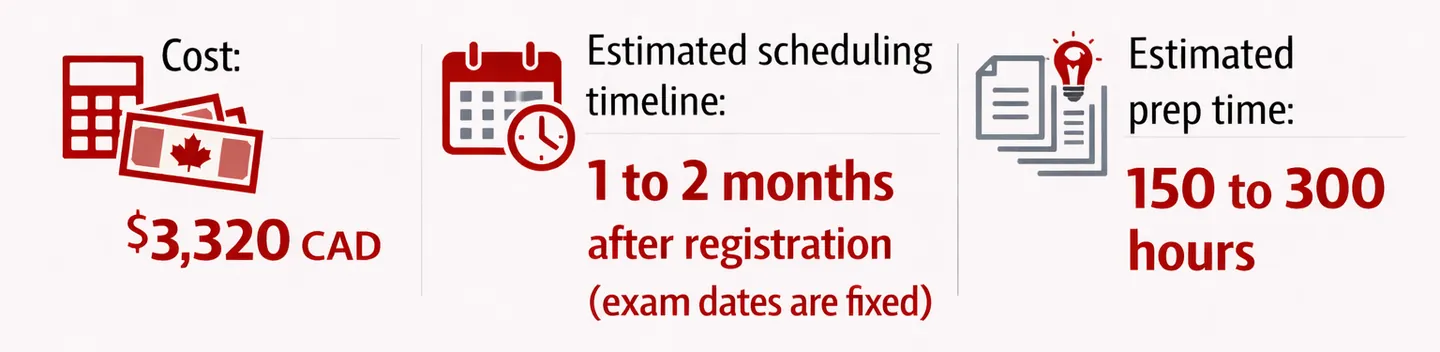
Cost: $3,320 CAD
Estimated scheduling timeline: 1 to 2 months after registration (exam dates are fixed)
Estimated prep time: 150 to 300 hours
I’ve seen very strong candidates struggle with the NAC OSCE, not because they didn’t know medicine, but because they hadn’t adapted to how medicine is practiced here.
The NAC OSCE evaluates:
- Communication
- Clinical reasoning
- Structure of patient encounters
It’s less about what you know, and more about how you express it.
Subtle differences in approach, how you guide a conversation, how you explain decisions, matter more than people expect. And that’s often where IMGs lose ground.
What it actually costs
The registration fee for the NAC OSCE is $3,320 CAD.
If you need to withdraw from the exam, refunds depend on when you cancel, but a portion of the fee is always retained. Unlike MCCQE Part I, this exam is offered on fixed dates, so rescheduling flexibility is limited.
In addition to the exam fee, many candidates invest in preparation courses, practice sessions, or study materials. While optional, these can add significant additional costs depending on what you choose.
At this stage, the NAC OSCE becomes one of the most expensive single steps in the IMG pathway, which is why planning your timing and preparation carefully is important before registering.
How long it actually takes
The NAC OSCE is offered only a few times per year, which means your timeline depends heavily on available exam sessions.
After registering, most candidates wait 1 to 2 months or more before their exam date, depending on when they apply relative to the exam cycle.
Preparation typically takes a few months. Most IMGs spend well over a hundred hours practicing cases, refining communication, and adapting to the expected clinical style.
Step 4: Applying Through CaRMS (The Main Bottleneck)
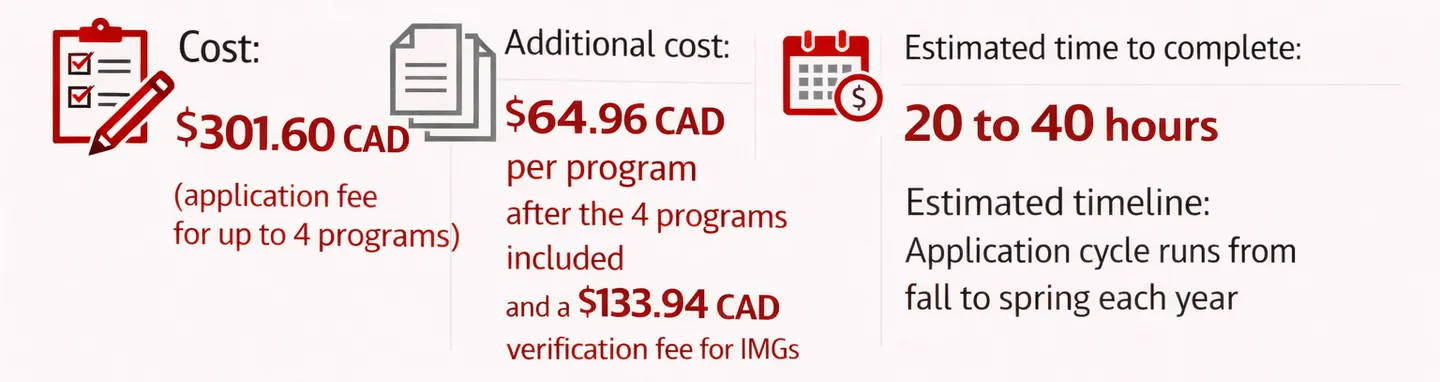
Cost: $301.60 CAD (application fee for up to 4 programs)
Additional cost: $64.96 CAD per program after the 4 programs included and a $133.94 CAD verification fee for IMGs
Estimated timeline: Application cycle runs from fall to spring each year
Estimated time to complete: 20 to 40 hours
This is the point where everything converges, and where the process becomes most competitive.
Every year, there are more qualified IMG applicants than there are residency positions.
I’ve had conversations with candidates who did everything right and still didn’t match. That’s not a reflection of their ability, it’s the reality of the system.
But when you look at those who do match, certain patterns stand out.
They have:
- Strong exam performance
- Some level of Canadian clinical exposure
- Relevant reference letters
- A realistic and well-positioned application
They’re not just qualified. They’re aligned with what the system is looking for.
What it actually costs
The base application fee for CaRMS is $301.60 CAD, which allows you to apply to up to 4 programs.
If you apply to more than 4 programs, each additional application costs $64.96 CAD per program. For applicants that did not complete their medical education in Canada there is an additional verification fee of $133.94 CAD.
In practice, most IMGs apply broadly, which means total application costs often increase beyond the base fee.
Beyond CaRMS itself, there are additional costs that are not always obvious at first:
- Translation of documents if required
- Costs associated with obtaining letters of reference
- Travel expenses for interviews, although many are now virtual
So while the official CaRMS fee may seem modest compared to exams, the total cost of this stage can still add up depending on how widely you apply.
Choosing the Right Specialty as an IMG
This is one of the most important strategic decisions you’ll make.
I’ve seen people spend years applying to highly competitive specialties without success, simply because they didn’t adjust their approach.
Most IMG matches in Canada happen in:
- Family Medicine
- Internal Medicine
That doesn’t mean you’re limited to those fields forever. But for many, they represent the most realistic entry point into the system.
And once you’re in, your options expand.
Provincial Requirements and IMG-Friendly Pathways
Another piece that’s often overlooked is geography.
Many applicants focus on major cities like Toronto or Vancouver, but the highest need for physicians is often elsewhere.
Provinces like:
- Saskatchewan
- Manitoba
- Nova Scotia
Have developed more accessible pathways for IMGs, including structured programs designed to bring physicians into underserved areas.
Understanding where opportunities actually exist can significantly improve your chances.
Practice Ready Assessment (PRA): An Alternative Route
For IMGs who already have independent clinical experience, there is another pathway worth considering.
Practice Ready Assessment (PRA) programs allow experienced physicians to undergo supervised assessment and transition into practice without completing a full Canadian residency.
There are conditions:
- You must have prior independent experience
- You will typically work in underserved areas
- There is often a return-of-service commitment
But for the right candidate, this can be one of the most direct ways into the Canadian system.
What Actually Determines Success as an IMG
After following enough of these journeys, one thing becomes clear.
Success isn’t just about knowledge or effort. It’s about understanding how the system works and making decisions accordingly.
The candidates who succeed tend to:
- Start early
- Take exams seriously
- Gain Canadian exposure where possible
- Apply broadly and strategically
- Adjust after setbacks
The ones who struggle often delay decisions or approach the process without a clear strategy.
The Reality of Matching
Not everyone matches on their first attempt.
And that’s one of the hardest parts of this process.
But the candidates who eventually succeed treat that outcome as feedback. They strengthen their application, refine their approach, and try again with a clearer understanding of what’s required.
IMG Opportunities in Canada (2026 Outlook)
There is increasing pressure on the system to address physician shortages, and that has led to gradual changes.
We’re seeing:
- Expansion of PRA programs
- More IMG-targeted initiatives
- Greater provincial involvement in recruitment
But the system remains selective.
It’s opening, just not widely.
Final Thoughts: How to Approach the Journey
If you’re serious about coming to Canada as an IMG, the most important shift you can make is this:
Stop thinking of it as a checklist, and start thinking of it as a system.
Because once you understand how that system filters candidates, your decisions become more intentional.
And that’s ultimately what moves you forward.