
The Best Study Timetable for Medical Licensing Exams
Build a sustainable study timetable for USMLE, MCCQE, or PLAB. Weekly schedules, QBank strategy, and burnout-proof rest days for medical licensing exams.

How to build a realistic weekly schedule for USMLE, MCCQE, or PLAB, without burning out by week six.
Ask ten IMGs how they structured their study timetable for USMLE, MCCQE, or PLAB, and you'll get ten different answers. Some swear by 12-hour marathon days. Others prefer tightly boxed 6-hour blocks with hard stops. None of them are wrong, exactly. But most of them are guessing, adjusting on the fly, and burning out somewhere around week six.
A good study timetable for medical exams isn't about cramming the most hours into a day. Instead, it's about sequencing your question bank practice, content review, and rest so your brain can actually absorb and recall material under exam pressure. That's the difference between a schedule that looks impressive on paper and one that actually gets you to pass day ready.
This article walks through how to build a realistic weekly timetable. It also covers how a USMLE study schedule, an MCCQE study plan, and a PLAB 1 study timetable each differ from one another, plus how to avoid burnout studying for medical exams: the thing that derails so many otherwise well-prepared candidates.
In this article
- What a Study Timetable Actually Needs to Do
- The Core Weekly Structure
- Adjusting the Timetable by Exam
- Balancing Question Banks, Revision, and Rest
- Signs Your Timetable Needs Adjusting
- A Sample 8-Week Timetable Overview
- Tracking What's Actually Working
- Frequently Asked Questions
- Key Takeaways
What a Study Timetable Actually Needs to Do
Before laying out blocks and hours, it helps to be clear on what the timetable is for. A licensing exam schedule needs to do three things at once:
- Build content knowledge through review of high-yield material
- Train exam reasoning through timed question bank practice
- Protect your capacity to keep going for weeks or months without collapsing
Most study plans over-index on the first two and ignore the third entirely. That's usually where things fall apart.
The Core Weekly Structure
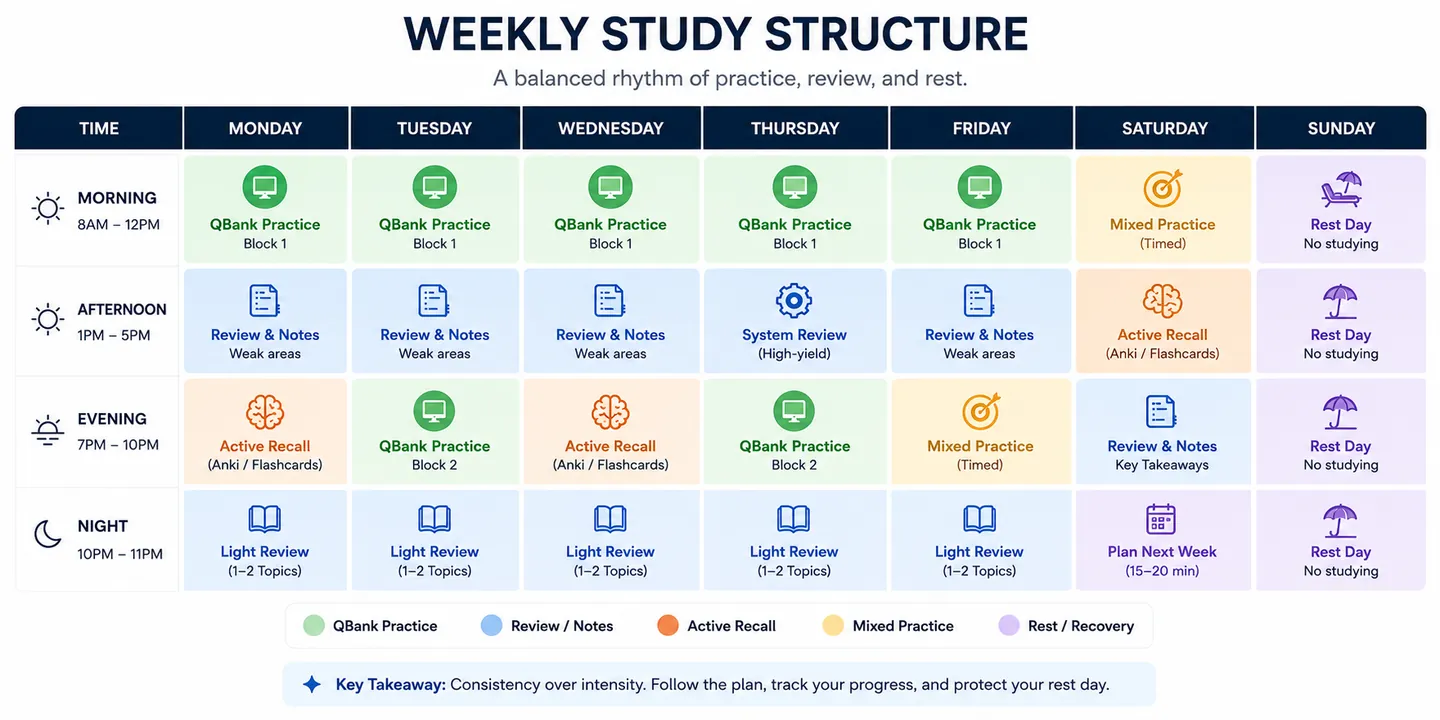
Regardless of which exam you're preparing for, a sustainable week tends to follow the same underlying shape.
Weekdays (5-6 days)
- A block of timed question bank practice, done in the morning while focus is sharpest
- A review block covering every question you got wrong, plus the reasoning behind the correct answer
- A shorter content review block targeting your weakest systems or topics
- Active recall practice, flashcards, self-testing, or teaching concepts out loud, rather than passive re-reading
One rest day per week
This is non-negotiable. It's not a light study day: it's an actual day off. If you're studying for exams that run 6 to 10 dedicated weeks, one full rest day weekly is what keeps the final stretch functional instead of foggy.
Here's roughly how that looks laid out across a week:
| Day | Focus |
|---|---|
| Monday | QBank block (AM) + review + weak-topic content |
| Tuesday | QBank block (AM) + review + active recall |
| Wednesday | QBank block (AM) + review + weak-topic content |
| Thursday | QBank block (AM) + review + active recall |
| Friday | QBank block (AM) + review + weekly self-assessment or practice test (every 1-2 weeks) |
| Saturday | Lighter QBank + consolidation of the week's weak areas |
| Sunday | Rest |
This isn't a rigid template to copy exactly. It's a shape. Scale the actual hours and question counts to your exam, your baseline knowledge, and how many weeks you have.
Adjusting the Timetable by Exam
USMLE (Step 1 and Step 2 CK)
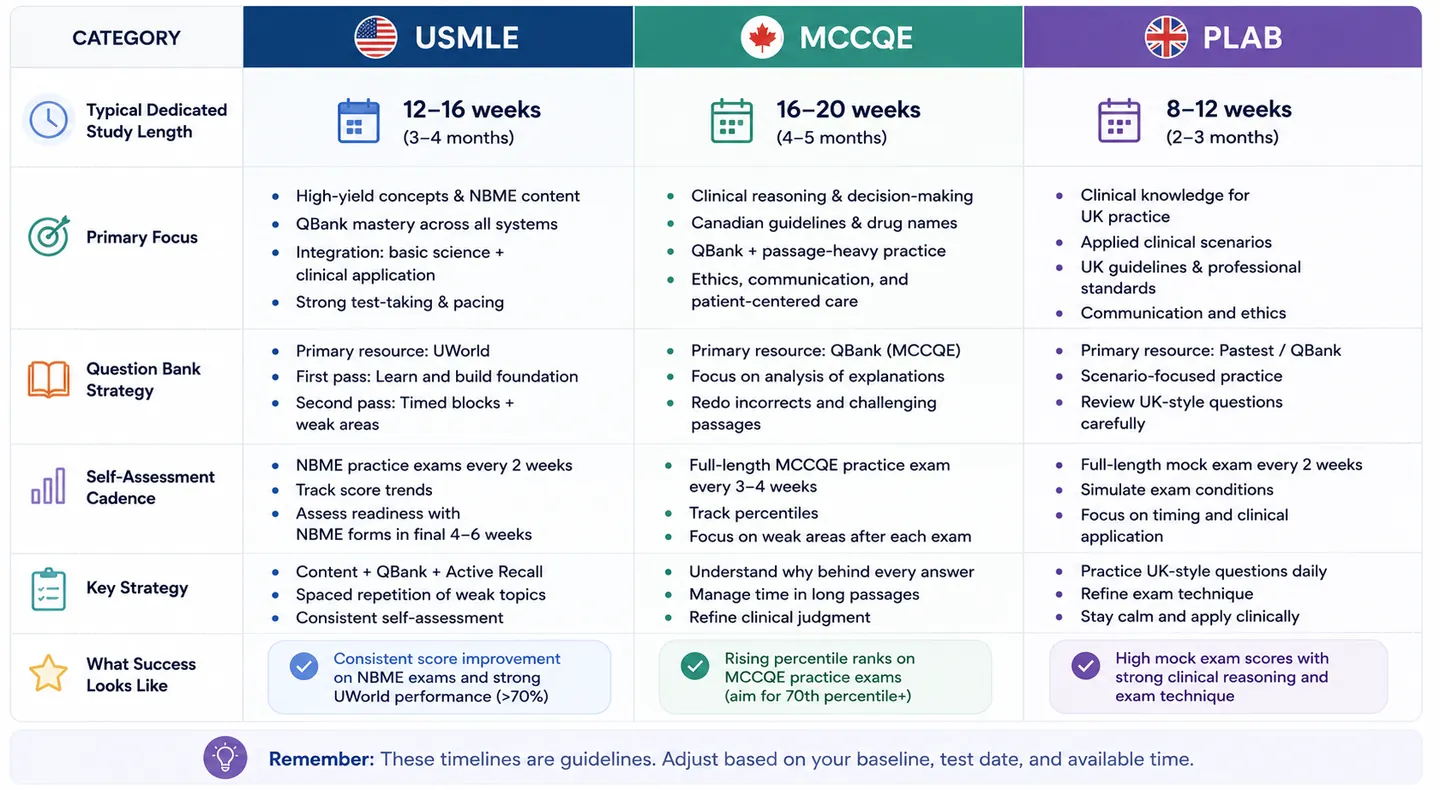
A USMLE Step 1 dedicated study period commonly runs four to eight weeks. Most students settle in the six-to-eight-week range, depending on how strong their preclinical foundation already is. A typical dedicated day within that USMLE study schedule involves a timed question block in the morning. After that comes several hours reviewing those questions in depth, plus additional hours on weak-area content review.
Self-assessment tests are where a lot of students go wrong. Some avoid them out of anxiety. Others take too many too close together. The general guidance from prep resources referencing NBME's own self-assessments is to space these roughly every one to two weeks throughout your dedicated period. Start with an older form as a baseline, and save the most recent forms for closer to your test date. Treat each one as a diagnostic, not a verdict. For example, if your microbiology score dips, that's your Thursday content block for the next two weeks, not a reason to panic.
MCCQE Part I
The MCCQE Part I is a one-day, computer-based exam built around clinical presentations rather than neatly organized specialty topics. This changes how you should study for it. Rather than working system by system in isolation, timetables built for MCCQE benefit from practicing clinical vignettes that mirror how the real exam presents a chief complaint and asks you to reason toward a next step.
Most guidance around building an MCCQE study plan recommends starting four to six months out. Early weeks should weigh more toward content review, while later weeks shift toward timed practice questions aligned to the MCC Objectives. If you're an IMG, note that eligibility depends on your medical school carrying the appropriate Canada Sponsor Note in the World Directory of Medical Schools. It's worth confirming this before you build your timetable around a specific exam date.
PLAB
A PLAB 1 study timetable tends to be shorter and more front-loaded on applied clinical reasoning, since PLAB 1 leans heavily on scenario-based single-best-answer questions rather than pure recall. A realistic version of it usually runs 8 to 12 weeks. Early weeks split between content review and question practice. Then, in the final two to three weeks, the plan shifts almost entirely into timed question blocks and full mock exams under real time constraints.
For PLAB 2, the clinical skills exam, your timetable needs a different rhythm entirely. Instead of sitting alone with a question bank, build it around practicing consultations and communication stations out loud, ideally with a study partner or small group.
Balancing Question Banks, Revision, and Rest
The most common mistake in self-built timetables isn't lack of discipline: it's lack of balance. Here are a few patterns worth watching for.
Too much QBank, not enough review. Blazing through 100 questions a day feels productive. However, if you're not spending real time understanding why each wrong answer was wrong, you're just accumulating exposure without accumulating understanding. Our question bank strategy for licensing exams article breaks down how to get more out of every block you run.
Passive review disguised as revision. Re-reading notes or highlighting a textbook feels like studying. In reality, it rarely builds the kind of retrieval strength these exams test for. If you haven't looked into how active recall and spaced repetition change retention, it's worth reading before you lock in your timetable. Our piece on active recall and spaced repetition in medicine covers the mechanics in more detail.
No rest built in until burnout forces it. If you're wondering how to avoid burnout studying for medical exams, this is the pattern to fix first: it's the most damaging one. Skipping rest days doesn't buy you more preparation: it borrows against the weeks ahead. As a result, fatigue compounds, review quality drops, and question bank accuracy starts to slide right when you need it climbing.
No sense of how long the full timetable should even run. Building a weekly structure is only useful once you know your total runway. If you haven't worked out your target study length yet, our guide on how long to study for a medical licensing exam is a good place to start before you fill in daily blocks.
Signs Your Timetable Needs Adjusting
A timetable isn't something you set once and follow blindly for two months. Watch for these signals that it needs a revision:
- Your question bank accuracy has plateaued or dropped over two consecutive weeks
- You're consistently unable to finish your planned blocks, even on rest-adjusted days
- Self-assessment scores aren't trending upward between attempts
- You feel depleted rather than tired: a distinction that matters more than it sounds
Any one of these is a signal to adjust load, not push harder. Sometimes that means reducing daily question volume and increasing review depth. Other times, it means adding a second rest day for one week. Either way, the timetable should serve your retention, not the other way around.
A Sample 8-Week Timetable Overview
| Weeks | Focus |
|---|---|
| 1-2 | Baseline self-assessment, content review weighted toward weakest systems, moderate QBank volume |
| 3-5 | QBank volume increases, review depth stays high, self-assessment every 1-2 weeks |
| 6-7 | Timed full-length practice exams, targeted review of persistent weak areas |
| 8 | Light review only, final self-assessment early in the week, deliberate taper toward test day |
Adjust the total length up or down depending on your exam and your starting point. Still, the taper at the end, deliberately reducing intensity in the final days, matters regardless of which exam you're sitting.
Tracking What's Actually Working
A timetable is only as useful as your ability to see whether it's working. That means tracking more than just hours studied. Daily QBank accuracy, weak subject trends, and self-assessment trajectory over time all tell you far more than a checked box on a calendar.
Track your progress with Sentia's analytics.
Frequently Asked Questions
How many hours a day should I study for USMLE or MCCQE?
Most sustainable timetables land between 6 and 10 focused hours on study days. Quality of review matters more than raw hours logged.
How often should I take self-assessment or practice exams?
Roughly once every one to two weeks during your dedicated study period. Space them out enough to actually act on the feedback between attempts.
Should my study timetable look different for MCCQE than USMLE?
Yes. MCCQE rewards practicing clinical-presentation-based reasoning aligned with the MCC Objectives. USMLE timetables, on the other hand, tend to be organized more heavily around systems and question bank volume.
Is one rest day per week really necessary?
Yes, for any dedicated study period running six weeks or longer. It's one of the most consistently cited protections against late-stage burnout.
What if I fall behind my timetable?
Adjust the plan instead of abandoning it. Compress lower-yield content review first, before you touch question bank practice or rest days.
Can I reuse the same timetable structure for PLAB or other exams?
Yes. The underlying weekly shape, QBank, review, active recall, rest, transfers well. Just adjust the weighting and total timeline to fit the exam's format and your starting point.
Key Takeaways
- A good study timetable balances question bank practice, deep review, and genuine rest, not just hours logged.
- USMLE, MCCQE, and PLAB timetables share a common weekly shape but differ in weighting and total length.
- Self-assessments should be spaced roughly every one to two weeks and used diagnostically, not as a verdict.
- Burnout is usually a scheduling failure, not a discipline failure. One rest day a week is protective, not optional.
- Tracking your actual performance trends matters more than following a rigid schedule to the letter.
Building a Timetable You Can Actually Sustain
The best study timetable isn't the most aggressive one. Instead, it's the one you can hold steady for the number of weeks your exam actually requires. Build in review depth, protect your rest days, and let your self-assessment data adjust the plan as you go, rather than sticking to a schedule that stopped reflecting reality three weeks ago.
Track your progress with Sentia's analytics.