
What Is an IMG? Meaning, Definition and Who Qualifies
A clear definition of International Medical Graduate status, IMG vs FMG, who qualifies, and licensing pathways for the US, UK, Canada and Australia.

An IMG is an International Medical Graduate, a doctor whose medical degree comes from a school outside the country where they now want to train or practice. That's the International Medical Graduate meaning in one line. It says nothing about your passport, your accent, or how good your medical school was. It describes one thing: where you studied.
That answers the question. It doesn't answer the ones that follow. Am I still an IMG if I'm a citizen of the country I'm applying to? Is IMG the same thing as FMG? Does the label change the exams I sit for or the years ahead of me? Those are the parts people get wrong, and getting them right early matters because your IMG status shapes almost every step that comes next.
The definition, in plain terms
The most widely used definition comes from ECFMG, a division of Intealth, which certifies international doctors entering the US health system. ECFMG considers you an IMG if you received your basic medical degree from a medical school located outside the United States. The location of the medical school, not the citizenship of the individual, determines IMG status.
Read that twice, because it cuts both ways. A US citizen who studied medicine in Grenada, Poland, or the Philippines is an IMG. A Nigerian citizen who graduated from a medical school in Ohio is not.
The UK's General Medical Council, Australia's Medical Board, and Canada's Medical Council all apply the same logic with their own borders drawn around it. So the label is relative to a destination: a doctor trained in Boston isn't an IMG in America but is one everywhere else.
Who qualifies as an IMG?
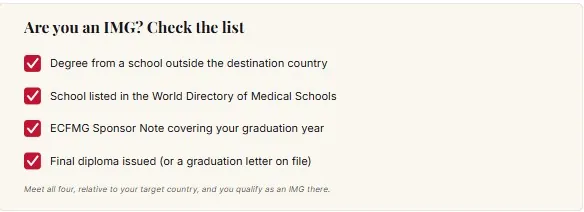
You're an IMG if your primary medical qualification, MBBS, MBChB, MD, or the local equivalent, was awarded by a medical school outside the country you're applying to work in. That school appears in the World Directory of Medical Schools, run jointly by WFME and FAIMER.
For the United States, there's one more box, and it's the one that catches people out. Your school's World Directory listing must carry an ECFMG Sponsor Note covering your graduation year. Not the school's reputation, not its pass rates, but that note is what confirms its graduates may apply. Check it before you enroll, not after you graduate.
Two updates worth knowing. Canadian graduates are now IMGs in the US: anyone finishing a Canadian medical school on or after 1 July 2025 needs ECFMG certification to enter US graduate medical education, while earlier graduates aren't IMGs and can't apply for it at all. And you don't need the diploma in hand to start; students can begin certification and sit USMLE Step exams while still in school.
Who does not qualify
Graduates of medical schools in the destination country aren't IMGs there, regardless of their nationality. Nor are students who haven't finished their international medical studies until the diploma exists. And IMG is a physician term: internationally trained nurses, dentists, and pharmacists have their own regulators and their own vocabulary.
IMG vs. FMG: What's actually different?
Very little, and that's the honest answer.
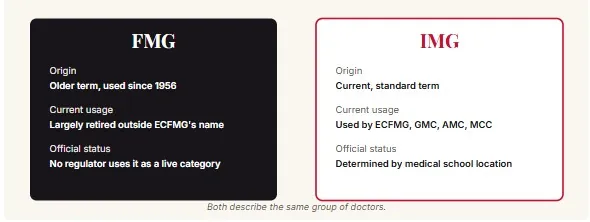
FMG: Foreign Medical Graduate is the older label. IMG replaced it, partly because "foreign" described the person rather than the training and partly because it was often just wrong: many of the doctors being described were citizens coming home. The old word survives mainly inside the name of ECFMG itself, a fossil from 1956.
You'll see blogs claim IMG means a citizen who trained abroad, while FMG means a non-citizen. No regulator draws that line. What regulators do track is a different split, and it's the one that carries real weight.
| Term | What it means | Why it matters |
|---|---|---|
| IMG | Trained outside the destination country | Sets which certification and exams apply to you |
| FMG | Older word for the same group | Historical: treat it as a synonym |
| US-citizen IMG | A citizen who studied medicine abroad | No visa sponsorship needed |
| Non-US-citizen IMG | Non-citizen who studied medicine abroad | Usually needs sponsorship, and that changes outcomes |
Why the distinction matters
Being an IMG says nothing about how good a doctor you are. It says a great deal about your paperwork, and the paperwork is real.
In the US, the label triggers requirements domestic graduates never face: ECFMG certification for IMGs is required before entering an ACGME-accredited residency, before sitting USMLE Step 3, and before any state grants an unrestricted license. That means Step 1 and Step 2 CK, credential verification directly with your medical school, and one of six ECFMG Pathways, each requiring a satisfactory score on OET Medicine, with no exemption for native English speakers.
It shows up in outcomes, too. The latest IMG residency match statistics, from the 2026 Main Residency Match, show 93.5% of US MD seniors matched to a first-year position. Among IMGs, 70% of US citizens matched, a record high, while 56.4% of non-US citizens did. Within that second group, applicants needing visa sponsorship matched at 54.4%, a five-year low, against 67.9% for those already holding permanent residency. Same schools. Same exams. Different immigration status.
Read those numbers as a planning tool, not a verdict. Nearly 12,000 non-US-citizen IMGs applied that year, and thousands matched. Much of the gap comes down to timing, preparation, and visa status, and two of those three are yours to control.
The pathways IMGs commonly follow
Every country runs its own gate, but each is asking the same four questions: Are your credentials genuine? Do you know enough medicine? Can you handle a patient? And can you communicate? Here's how IMG pathways by country compare in practice.
| Destination | Gatekeeper | What the route usually involves |
|---|---|---|
| United States | ECFMG / Intealth | ECFMG Certification: eligible school in the World Directory, USMLE Step 1 and Step 2 CK, plus one of six Pathways (each including OET Medicine). Then ERAS and the NRMP Match. |
| United Kingdom | GMC | Usually PLAB 1 and PLAB 2, now aligned to the UK Medical Licensing Assessment, plus IELTS or OET. Recognized postgraduate qualifications and the Portfolio Pathway are alternatives. |
| Australia | AMC / Medical Board | Standard pathway (AMC MCQ, then the AMC clinical exam or a workplace-based assessment), or the Competent Authority pathway for doctors from comparable systems. Supervised practice follows either way. |
| Canada | MCC | MCCQE Part I and the NAC OSCE, then a highly competitive CaRMS match. |
For the US route, stage by stage, read how to become an IMG and the checklist of IMG requirements. To see how the years stack up, the IMG timeline maps it out.
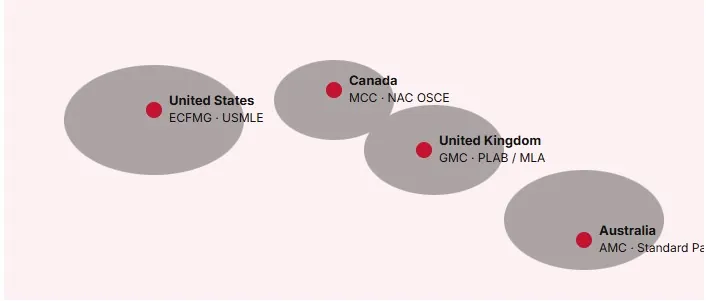
IMG status is relative to a destination: each country runs its own gatekeeper and exam route.
The challenges nobody warns you about
The waiting. Credential verification depends on your medical school answering someone else's email, and some schools take months. Domestic students apply to residency in their final year; you apply after graduating. Most IMGs sit through a gap of months, sometimes years.
The cost. Exams, applications, and travel run into thousands of dollars before you've bought a single question bank.
The competition. In the UK, more than two-thirds of recent new joiners to the medical register qualified outside the UK, yet international doctors' success rate in specialty training applications ran at 23%, against 69% for UK graduates. Getting registered and getting a training post are two different problems.
None of that argues against starting. It argues for starting early and preparing deliberately, which is why how you study matters as much as how long. Question banks you can shape around your weak areas, analytics that show where you honestly stand rather than where you feel you stand, and tools that keep working when the power or the network doesn't. Preparing alone, in a different time zone from your exam center, is a different sport from preparing on campus.
Common misconceptions
"IMG means I'm a foreigner."
It means you trained abroad. IMGs make up roughly a quarter of the US physician workforce, and many are American citizens.
"IMGs are second-tier doctors."
IMGs staff entire specialties on both sides of the Atlantic: internal medicine, family medicine, psychiatry, and geriatrics. The label describes a route, not a ceiling.
"My degree lets me practice anywhere."
Your degree qualifies you to begin a licensure process. It isn't a license.
"Once an IMG, always an IMG."
The status belongs to the destination, not to you. Change the country, and the label changes with you.
Frequently asked questions
What does IMG stand for?
International Medical Graduate: a doctor whose primary medical degree came from a school outside the country where they intend to train or practice.
Is a US citizen who studied medicine abroad an IMG?
Yes. Status follows the school's location, not the graduate's citizenship. These applicants are called US-IMGs, and they don't need visa sponsorship.
Is IMG the same as FMG?
For practical purposes, yes. FMG is the older term for the same group, and no regulator maintains two separate categories. Use IMG.
Do Canadian graduates count as IMGs in the United States?
Those finishing on or after 1 July 2025 do, and they need ECFMG certification. Earlier graduates are not IMGs and aren't eligible for it.
Do native English speakers still have to sit an English test?
For the US, yes. Every ECFMG Pathway requires a satisfactory score on OET Medicine, regardless of citizenship, first language, or the language of instruction at your medical school. ECFMG is explicit that there are no exceptions.
Does my school's accreditation affect my eligibility?
More subtly than most guides suggest. Intealth's Recognized Accreditation Policy, reporting since late 2024, shows whether your school's accrediting agency is recognized by WFME or NCFMEA. It's currently informational; you can still pursue ECFMG Certification without it, provided your school carries a Sponsor Note covering your graduation year.
Do I need ECFMG Certification to work in the UK or Australia?
No, it's for entry into US graduate medical education. But Intealth's credential-verification services are used well beyond the US, including by the Australian Medical Council, so that step tends to travel with you.
How long does the IMG journey take?
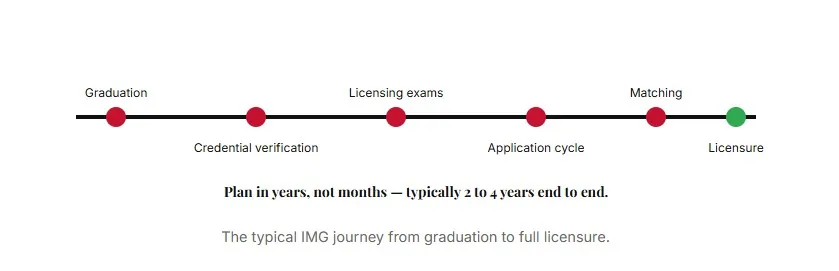
Plan in years, not months. Verification, exams, and at least one application cycle usually mean two to four years between graduating and starting residency.
Key takeaways
- IMG stands for International Medical Graduate. The location of your medical school decides it; your citizenship doesn't.
- US citizens who study abroad are IMGs. Non-citizens who study in the US are not.
- Canadian graduates from 1 July 2025 onward are now IMGs for US residency purposes.
- IMG and FMG describe the same group. IMG is the current term.
- Visa status, not the IMG label itself, explains much of the gap in match outcomes.
- Check your school's World Directory listing and Sponsor Note before you enroll.
Where to go from here
Being an IMG isn't a verdict on your ability. It describes where you studied, and it signals that your route into a new health system runs through a few extra checkpoints: credential verification, licensing exams, proof of clinical and communication skills, and supervised training. Thousands of doctors clear those checkpoints every year, and the ones who stall are rarely the ones who lacked ability. More often, they started late, planned in isolation, or trusted advice that had quietly expired. So get the definition right, confirm your school's listing, and map your timeline, and start earlier than feels necessary.
New to the IMG journey?
Join the Sentia Telegram community for step-by-step guidance, study resources, and support from fellow medical students and International Medical Graduates.
Join the Sentia Telegram community
This guide is one of many evidence-based resources in Sentia's growing medical library. Explore more clinical articles, create your own question banks, track your progress, and study on your terms with Sentia. Free to use, built for students, and designed to work even offline.
Related reading
- IMG vs FMG: the full breakdown, the historical split, and why regulators only track one of the two terms today.
- ECFMG certification for IMGs: a step-by-step guide: Pathways, Sponsor Notes, and how the application process actually runs.
- IMG residency match statistics, explained: what the NRMP's yearly numbers mean for your own odds.
- IMG pathways by country: US, UK, Canada, and Australia compared, a deeper look at each regulator's requirements.
Sources
- ECFMG, a division of Intealth: ECFMG Certification and Pathways for ECFMG Certification
- WFME and FAIMER: World Directory of Medical Schools
- Intealth: Recognized Accreditation Policy
- National Resident Matching Program: Results and Data: 2026 Main Residency Match
- General Medical Council (UK): PLAB and the MLA; workforce report
- Australian Medical Council and Medical Board of Australia: assessment pathways
Licensing rules change. Always confirm current requirements with the official body for your target country before making decisions.