
Why IMGs Fail Licensing Exams and How to Avoid It
Why IMGs fail licensing exams: passive study, no analytics, weak timing and isolation, plus the fixes that raise your pass odds.
On this page
- What the pass rates actually show
- The clue most people miss
- The pattern that should change how you prepare
- Reason 1: Studying passively and calling it studying
- Reason 2: Studying blind, with no idea where you're weak
- Reason 3: Getting the timing wrong at both ends
- Reason 4: Preparing completely alone
- Reason 5: Underestimating the format itself
- What failure does not mean
- How to put this into practice
- Frequently asked questions
- Key takeaways
- The bottom line
Why IMGs fail licensing exams is a question that comes up in almost every group of international medical graduates you'll meet. Someone studied for months and finished a full question bank, sometimes two. They were a strong student back home, often a practising doctor with years on the wards. Then the result came back as a fail, and nobody could quite explain why.
That story is far more common than most people realise, and it usually has very little to do with intelligence or clinical ability.
If you want to understand why IMGs fail licensing exams, the numbers are a good place to start, because they point to something specific. This isn't a knowledge problem so much as a preparation problem, and preparation is something you can change.
What the pass rates actually show
This is where why IMGs fail licensing exams starts to become measurable rather than anecdotal.
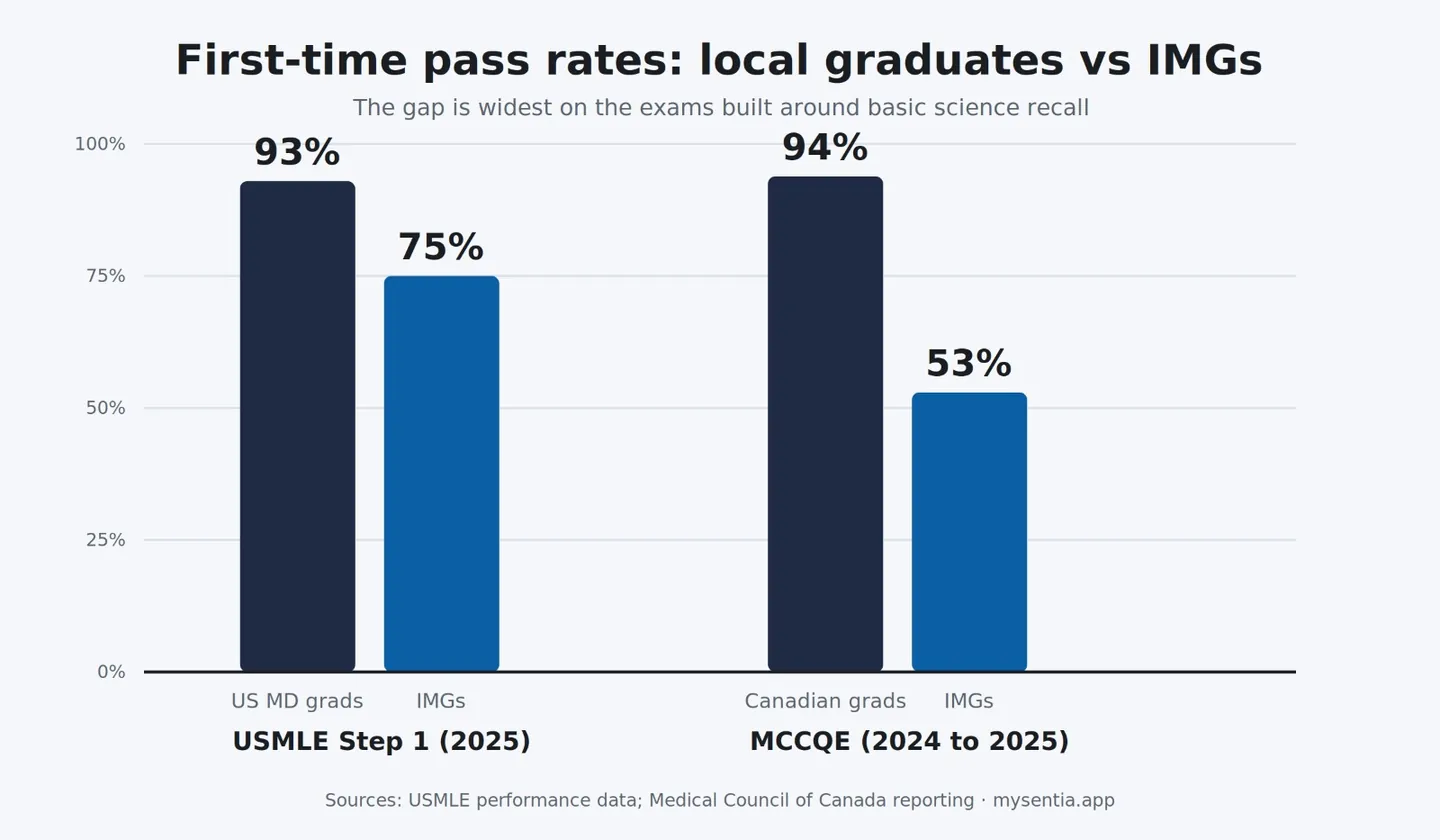
The USMLE Step 1 pass rate IMG figure for 2025 tells the first part of the story. In USMLE performance data, first-time examinees from non-US schools passed Step 1 at 75%, against 93% for first-time students from US MD-granting schools. Out of roughly 22,000 IMG first-timers, about one in four did not pass.
Canada tells a sharper version of the same story. The MCCQE pass rate IMG figure is even starker: in MCC reporting for 2024 to 2025, first-time Canadian graduates passed the MCCQE at around 94% while first-time IMGs passed at roughly 53%, so close to half did not get through.
Those gaps are wide, and it's easy to read them as a verdict on ability. Look closer and a different explanation appears.
The clue most people miss
This is the clue that reframes why IMGs fail licensing exams entirely. In that same 2025 data, IMGs passed Step 2 CK at 90% on the first attempt. That's the clinical knowledge exam, and IMG performance on it sits far closer to the US graduate rate than the Step 1 gap suggests.
Think about what that means. If IMGs were simply weaker doctors, the clinical exam is where they'd struggle most. It isn't. They perform strongly on the exam that most resembles patient care. Instead, they struggle on the one built around basic science recall and a particular question style.
So the problem isn't clinical competence. It's the gap between knowing medicine and being ready for a specific exam, in a specific format, against a specific blueprint. That's far more fixable.
The pattern that should change how you prepare
Now the single most important number in this article.
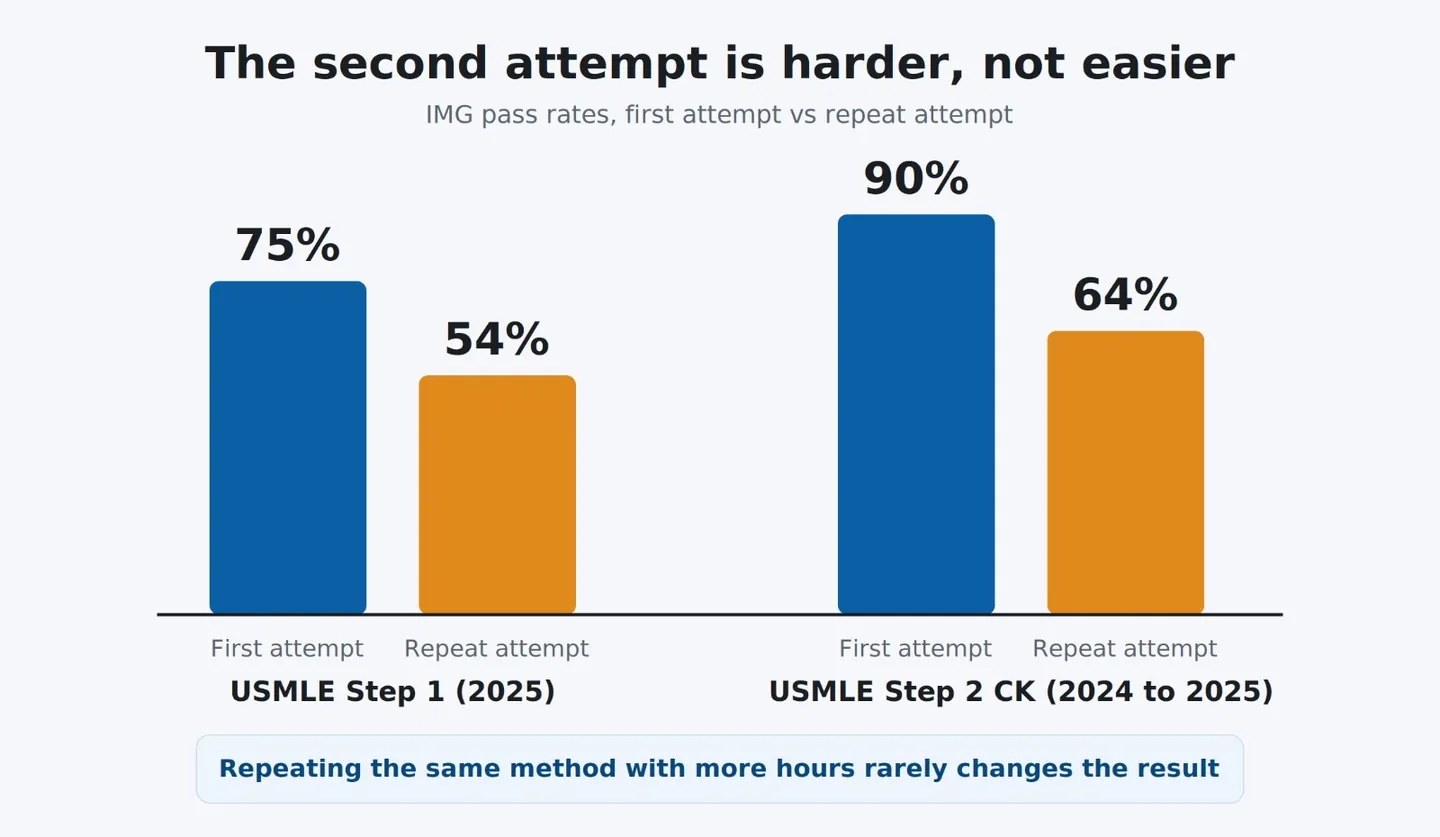
On Step 1 in 2025, IMG first-timers passed at 75% while repeat takers passed at 54%. On Step 2 CK it was 90% against 64%. Canadian data follows the same shape.
Read that again, because it runs against intuition. You'd expect a second attempt to go better. You've seen the exam, you know the format, you know roughly what you got wrong. Yet across every exam and every year, repeaters do substantially worse.
Why? Because most people who fail repeat the same preparation with more hours attached. Same resources, same passive habits, same blind spots, just harder. The strategy that failed is still the strategy.
Two lessons follow. Treat your first attempt as though it's the only one you get, because statistically it's your best chance. And if you've already failed, don't just study longer. Study differently. The reasons below are where "differently" lives.
Reason 1: Studying passively and calling it studying
If you're trying to understand why IMGs fail licensing exams, start here. This is the most common failure mode. However, it's also the hardest to see from the inside.
Rereading notes, rewatching videos, and highlighting textbooks all feel productive. You finish a session and you recognise the material, which your brain interprets as knowing it. Recognition and recall are not the same thing, and the exam only rewards one of them.
Question banks can be passive too. Plenty of candidates do thousands of questions, read the explanation, nod along, and move to the next one. The explanation makes sense, so it feels learned. Two weeks later, the same concept in a slightly different clinical vignette gets missed again.
The fix: make retrieval the default. For every question you get wrong, close the explanation and write one sentence in your own words explaining why the correct answer is correct. That single habit forces recall rather than recognition. It's slower per question and far faster per concept learned.
If you want the full method, our guide to question bank strategy goes deeper on how to work through a Qbank properly.
Reason 2: Studying blind, with no idea where you're weak
This is one of the most common IMG exam preparation mistakes. Even so, it's almost invisible from the inside.
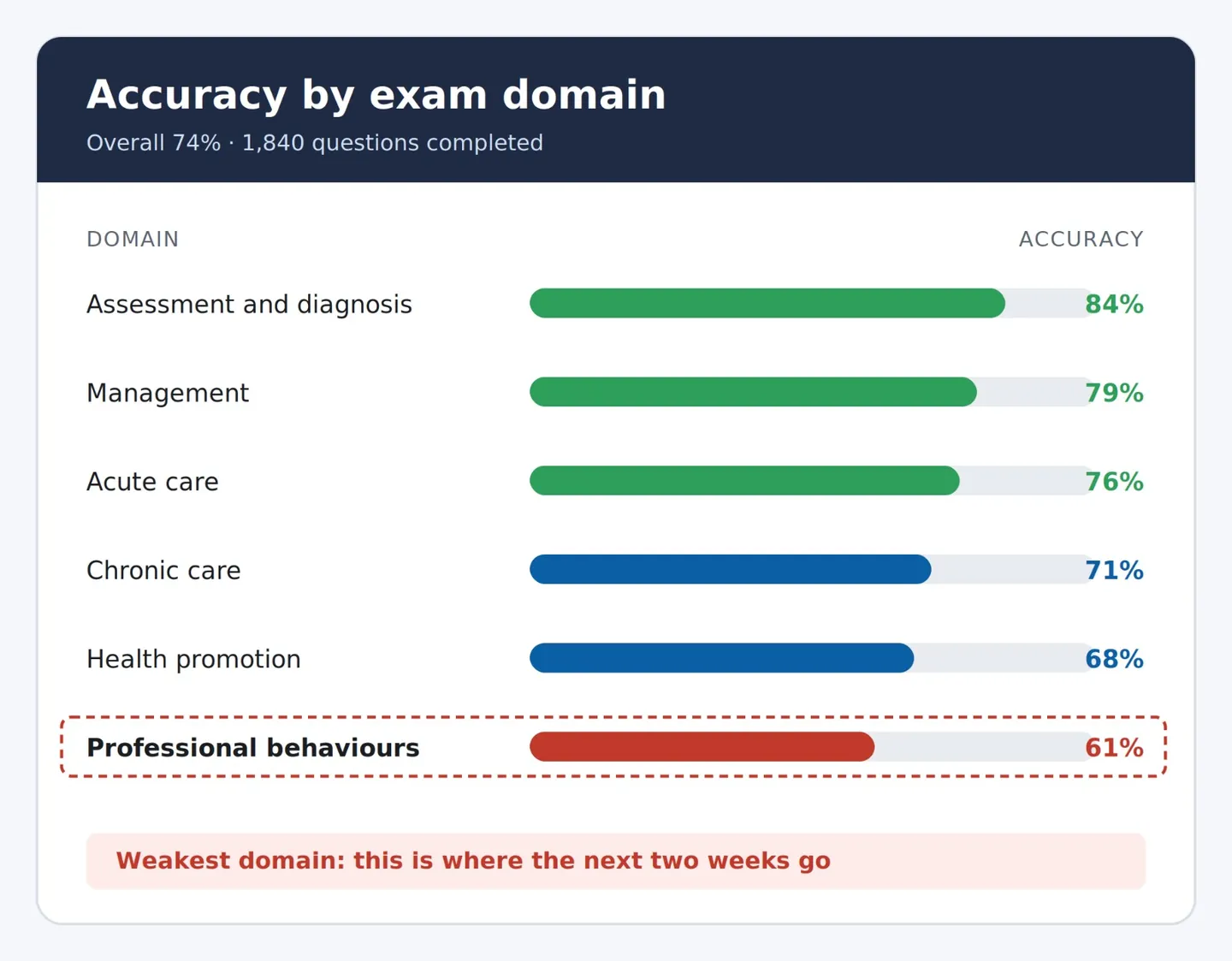
Ask a candidate two weeks from their exam how they're doing. Many will say something like "about 70%." However, ask which topics make up the gap, and the answer gets vague.
That vagueness is expensive. Being at 70% overall could mean you're evenly average everywhere, or excellent in most areas and badly exposed in two. Those need completely different plans, and you can't tell them apart without data.
Meanwhile most people gravitate to topics they already enjoy, because studying what you're good at feels better than studying what you're not. Weak areas stay weak right up to exam day.
The fix: track accuracy by topic or blueprint domain, not just overall. Knowing you're at 84% in diagnosis but 61% in a domain you've been quietly avoiding tells you exactly where the next fortnight goes. Then re-test those areas to confirm they actually improved, rather than assuming they did.
Reason 3: Getting the timing wrong at both ends
Timing is another quiet answer to why IMGs fail licensing exams. Failures here come in two flavours. Both are common.
Some candidates compress preparation into six weeks around a job, assuming intensity substitutes for coverage. It rarely does on an exam with a broad blueprint. Others study for two years, losing early material as fast as they gain new, and never feeling ready enough to book.
There's a subtler error too: sitting because a deadline arrived rather than because the evidence said you were ready. Residency timelines create real pressure, and plenty of people book a date they know they aren't prepared for and hope.
The fix: most IMGs balancing clinical work need roughly three to six months, but the calendar matters less than the evidence. Set a readiness marker in advance. For example, use a target accuracy across all domains on questions you haven't seen before, then use that to decide. Our guide on how long to study for a licensing exam works through this in detail.
Rehearse the endurance too. These are long exams. If exam day is the first time your concentration is tested at hour four, that's a problem you created rather than discovered.
Reason 4: Preparing completely alone
This one rarely appears on lists of study advice. However, it probably should.
Many IMGs prepare alone, often while working full time and in a different country from the exam they're sitting. A final-year student at a Canadian or US school has it easier. They're surrounded by classmates on an identical timeline, with shared resources and a constant sense of the pace.
Isolation costs you in three ways. You have no benchmark, so you can't tell whether your progress is normal or worrying. You also have nobody to explain concepts to. Teaching something, after all, is one of the most reliable ways to find out whether you truly understand it. And when motivation dips, which it will over several months, nothing holds the routine in place except willpower.
The fix: find even one or two people on the same timeline. Share difficult questions. Explain your reasoning out loud. Compare where you're each struggling. Our piece on why community matters for IMGs covers how to build that support if you're starting from scratch.
Reason 5: Underestimating the format itself
Format is the most overlooked reason why IMGs fail licensing exams. You can know the medicine. Even so, you can still lose marks to the exam's design.
These exams test reasoning through long vignettes, often with more information than you need and several defensible answers where only one is best. They also weight areas clinically strong candidates skim past. These include communication, professional behaviour, ethics, consent, capacity, and the norms of the health system you're testing into.
That last part catches experienced doctors more often than students. If you've practised for years in one system, some of your instincts are good medicine and the wrong answer here. Recognising that early isn't a criticism of your training. It's the gap between two systems.
The fix: study the published blueprint, not just a textbook table of contents. Map your revision to the exam's own domains. And practise with the real question style rather than short factual recall, because those are different skills.
What failure does not mean
The numbers here are stark. So it's worth being clear about what they don't say.
They don't say IMGs are weaker doctors, and the Step 2 CK figures argue strongly against that reading. They don't say a fail ends your journey either. Most exams allow several attempts, and plenty of people pass later and go on to match. It costs time and money. That's exactly why the first attempt deserves so much care. Even so, a fail is a setback rather than a verdict.
Nor are these exams unfair. They're criterion-referenced, so you're measured against a fixed standard rather than ranked against other candidates, and nobody else's performance raises the bar for you. The gap reflects differences in preparation, familiarity, and support, all of which you can influence.
How to put this into practice
Take the sequence rather than the list.
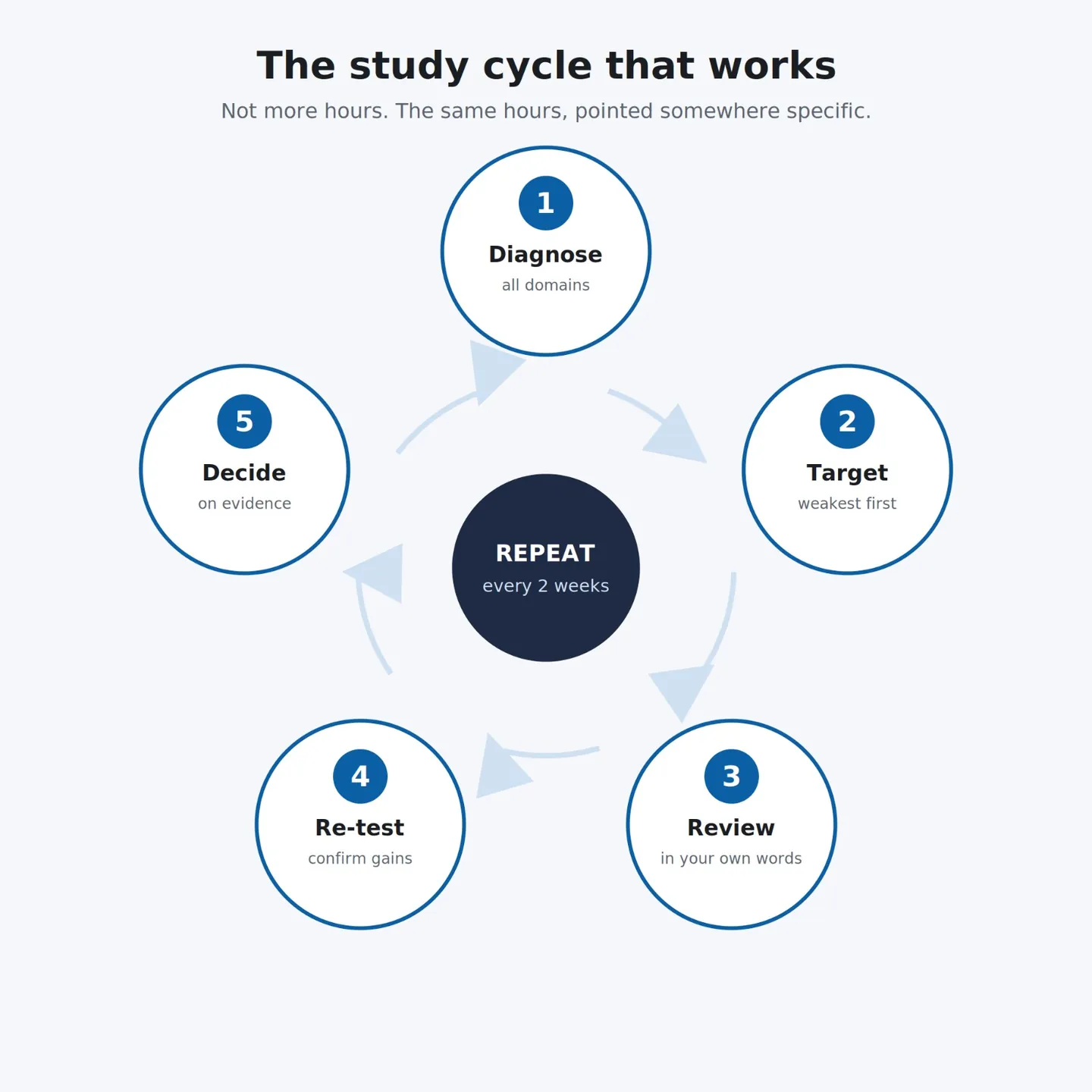
Start with a diagnostic across the full blueprint, so your plan rests on evidence instead of assumption. Study by domain, weakest areas first, even though they're the least pleasant. Make every question active by explaining the right answer in your own words. Track accuracy by topic and re-test to confirm improvement. Find at least one study partner. Then book on your readiness data, not the calendar.
None of that needs more hours than you're already spending. It needs those hours pointed somewhere specific.
Understanding why IMGs fail licensing exams is the easy part. Acting on it is what changes your result. Spot your weak areas early with Sentia's analytics, free to download. Then study offline wherever you are, so an unreliable connection never decides your revision for you.
Preparing for a licensing exam? Join the Sentia Telegram community instead. There, you'll find shared question banks, study partners, and honest advice from International Medical Graduates further along the same road. → https://t.me/+ixuxt5zYIGNjMWIx
Frequently asked questions
Why do IMGs fail licensing exams more often than local graduates?
The main drivers are preparation style, unfamiliarity with the exam format and blueprint, timing pressure, and studying without a peer group. Clinical ability is rarely the issue. That's why IMG pass rates on clinical knowledge exams are far closer to local graduate rates than basic science exam rates are.
What percentage of IMGs fail the USMLE, and why do IMGs fail licensing exams at this rate?
In 2025 USMLE performance data, 75% of first-time examinees from non-US schools passed Step 1, so roughly one in four did not. First-time Step 2 CK performance was considerably stronger at 90%.
Are repeat attempts easier?
The data says no. IMG repeat takers pass at markedly lower rates than first-timers on both Step 1 and Step 2 CK. The usual reason is that candidates repeat the same preparation method with more hours rather than changing the approach.
Does failing once ruin my chances of matching?
It makes the path harder rather than impossible. Programmes can see attempt history, so a fail carries weight, but many people pass on a later attempt and match successfully. It's a strong argument for preparing thoroughly before the first sitting.
How long should I study to avoid failing?
Most IMGs balancing clinical work need about three to six months. The better question is not how long but whether the evidence shows you're ready, measured on fresh questions across every domain.
Is it worth studying with other people if I'm short on time?
Yes, and it usually saves time rather than costing it. Explaining a concept to someone else surfaces gaps quickly, and having a peer benchmark stops you misjudging your own progress.
Key takeaways
- The IMG pass rate gap is real, but it reflects preparation and familiarity far more than clinical ability.
- IMGs pass Step 2 CK at 90% on the first attempt, which undercuts the idea that clinical competence is the problem.
- Repeat attempts have lower pass rates than first attempts, so treat your first sitting as your best chance.
- Passive review feels productive and is the most common hidden cause of failure.
- Overall percentages hide weak domains, so track accuracy by topic instead.
- Isolation removes your benchmark, your feedback, and your consistency.
- If you've already failed once, change the method rather than simply adding hours.
The bottom line
So, why do IMGs fail licensing exams? Not because of who they are as doctors. It comes down to a specific exam, a specific format, and a style of preparation that favours candidates who trained inside that system.
Seen that way, the fixes stop feeling out of reach. Study actively. Know your weak domains by name. Give yourself a realistic runway and decide your date on evidence. Find people going through the same thing. Prepare against the blueprint rather than the textbook you happen to own.
Candidates who do those things pass every session, from every country and every kind of medical school. The exam is hard, and it is beatable.
Sentia: offline-first question banks for medical students and International Medical Graduates. Pass rate figures cited here come from official USMLE performance data and Medical Council of Canada reporting, and should be reviewed annually.