Documents Needed Before ECFMG Registration
Exactly which documents to prepare before ECFMG registration; diploma, transcripts, ID and verification, with a free downloadable checklist.

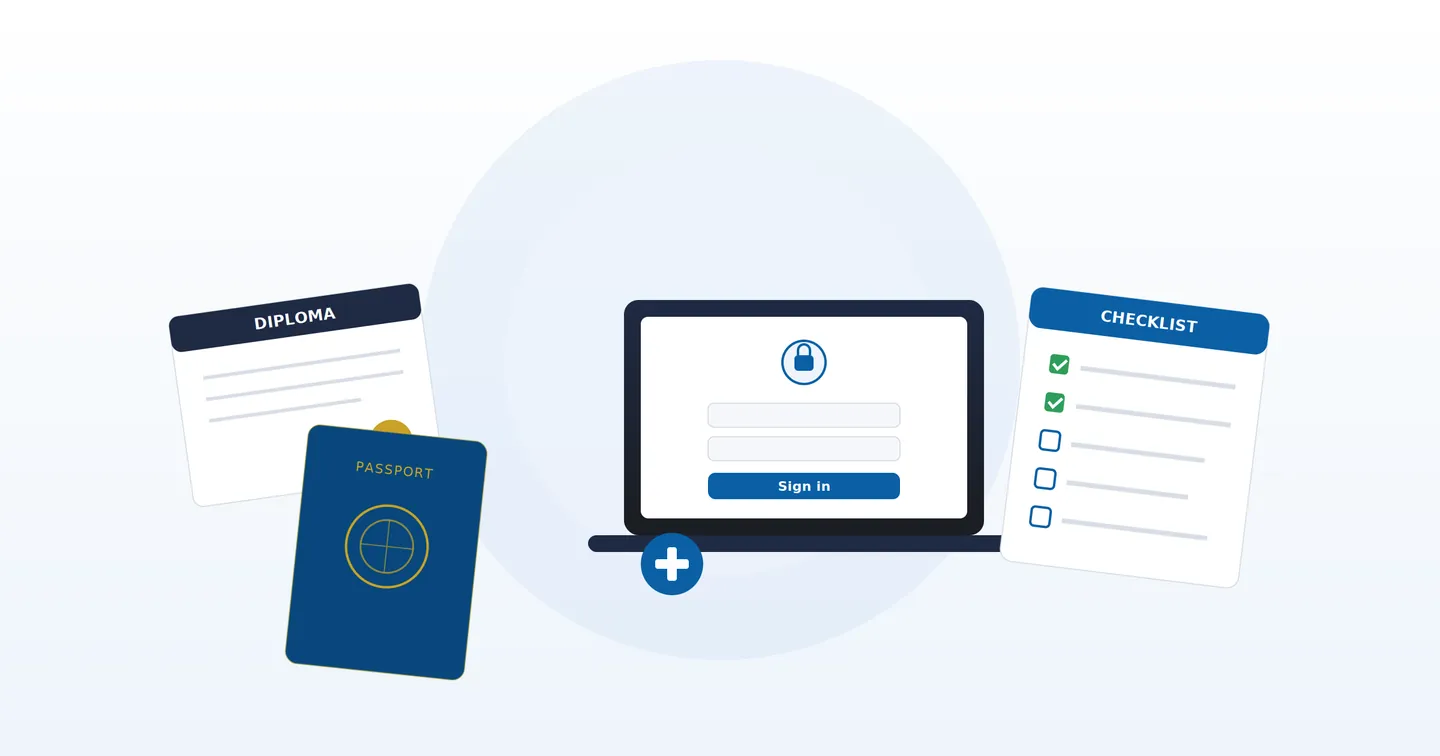
Most delays in the ECFMG process don't happen during the exams. They happen right at the start, over paperwork.
An IMG sits down to open their account, ready to finally begin the road to a US residency, and gets stopped by something small. A name on a passport that doesn't quite match the name in their record. A diploma still sitting with the registrar. A transcript that was never translated into English. None of it is hard to fix. All of it costs time, and in this process time is the one thing you can't buy back.
This guide walks through the documents for ECFMG you'll want ready before you register, why each one matters, and the two or three details that quietly trip people up. Get these sorted early and the rest of the journey gets a lot smoother. Everything here reflects the 2026 ECFMG Information Booklet, published by ECFMG, a division of Intealth.
There's a free downloadable checklist at the end, so you don't have to hold all of this in your head.
First, a quick note on names: it's not "ECFMG registration" anymore
If you've been reading older guides, you may be looking for an "ECFMG account" and an "ECFMG Identification Number." Those names have changed.
ECFMG's online portal is now called MyIntealth, and the ID you're issued is your MyIntealth Identification Number. The organisation behind it all, ECFMG, is a division of Intealth. The certification is still the ECFMG Certification, and most people still say "ECFMG registration," which is why this guide does too. Just don't be thrown when the login screen says MyIntealth. You're in the right place.
The two things that come before any document
Before ECFMG will even look at your medical credentials, two boxes have to be ticked. Miss either and your application stalls no matter how organised your paperwork is.
Your medical school has to be recognised. Your school must appear in the World Directory of Medical Schools with an ECFMG Sponsor Note confirming it meets eligibility requirements. And the graduation years listed in that note must cover your year. This is worth checking before you spend a single dollar. If your school isn't listed correctly, that's a conversation to have with your school and ECFMG first, because no document you submit will get around it.
Your personal details have to match your passport, exactly.
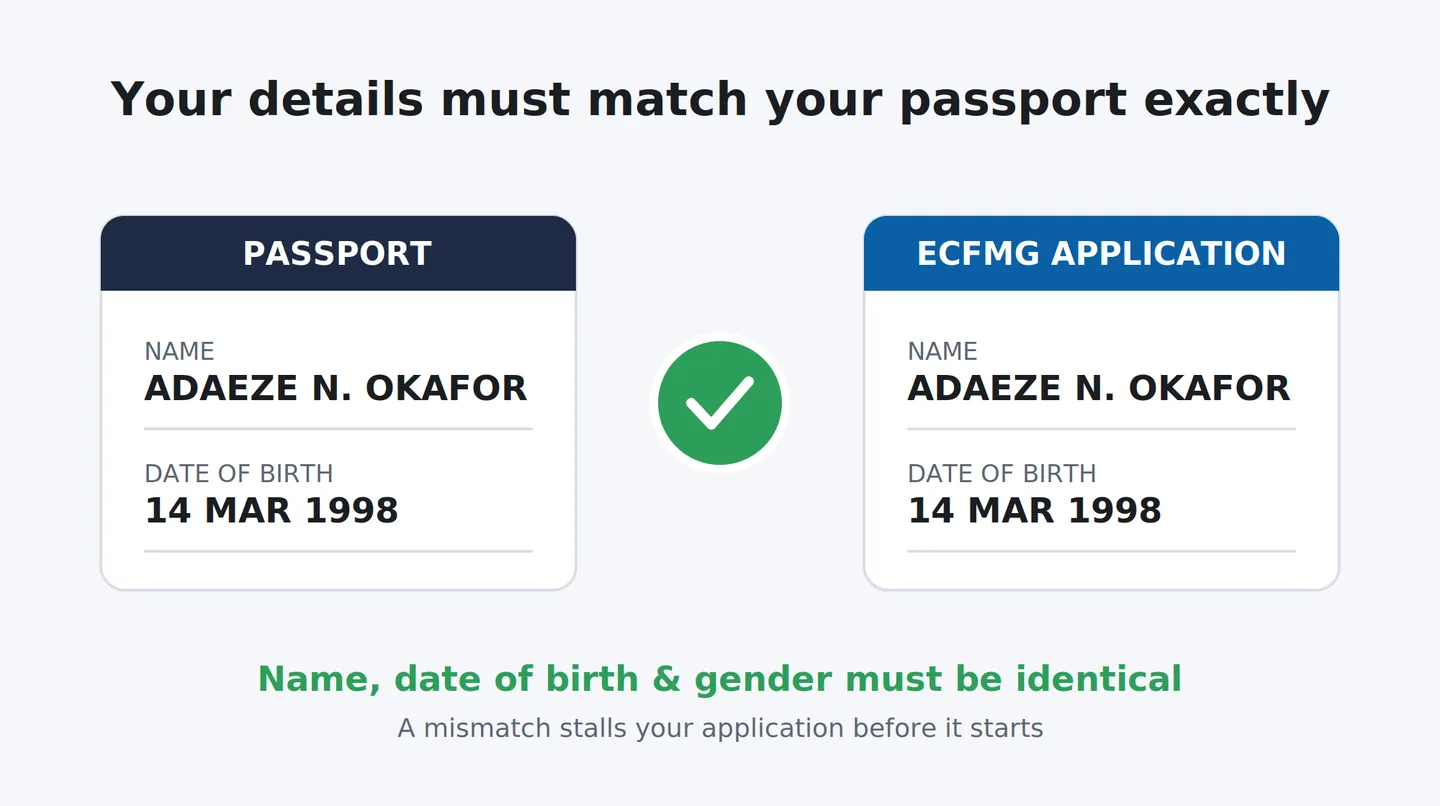
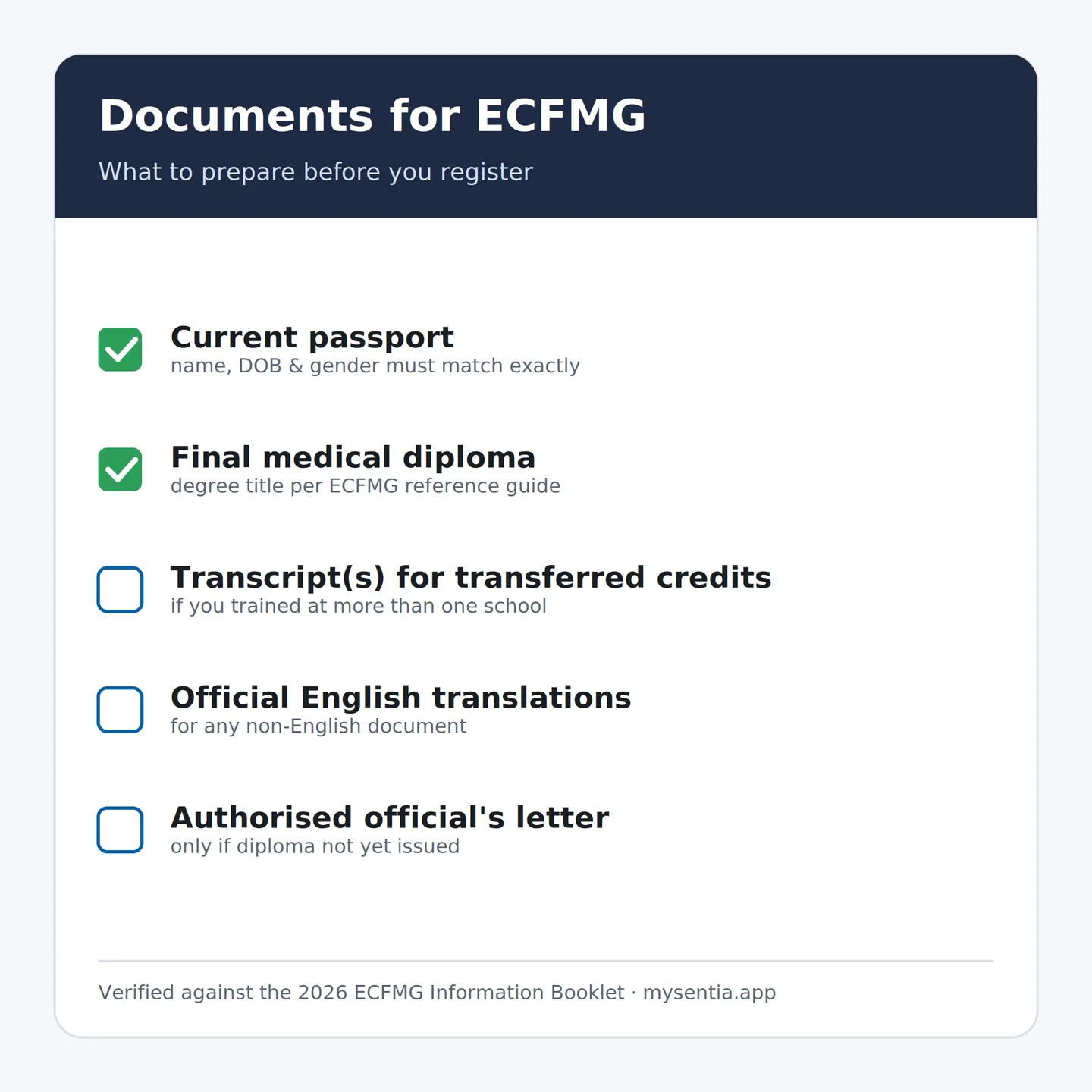
When you apply, ECFMG asks you to confirm your name, date of birth, and gender. These must match your current, unexpired passport precisely. Not "close enough." If your record says your name one way and your passport says it another, you'll have to correct your record before you can finish the application. So the very first document to put your hands on isn't your diploma. It's your passport.
The core medical education documents
Here's the heart of what ECFMG needs. The exact requirements depend on whether you've already graduated or you're still a student.
If you've already graduated
You'll need to submit, as part of your application:
- Your final medical diploma. A clear copy of the actual diploma awarding your medical degree. The degree title has to match what ECFMG expects for your school, which is published in ECFMG's Reference Guide for Medical Education Credentials. This matters for graduates of systems where the "final" qualification isn't always obvious.
- Transcripts documenting any transferred credits, if that applies to you. If you did part of your training at one school and finished at another, ECFMG needs to see the transfer documented.
Your final medical school transcript is also required, but you usually don't chase this one yourself. When ECFMG sends your diploma to your school for verification, it asks the school to return your final transcript at the same time.
If you're still a student
If you register while still in school, you submit transcripts to document transferred credits (if any apply) up front. Then, the moment you graduate and your diploma is issued, you go back into your application, update it, and submit a copy of your diploma. Your credentials still have to be verified before your application is fully accepted.
If you've graduated but the diploma hasn't been issued yet
This is common. You've finished, you've passed everything, but the physical diploma is weeks or months away. ECFMG allows for this. You submit a letter from an authorised official at your school, on official letterhead, as the original document, confirming you've completed all requirements. The letter has to include specific wording:
"This is to confirm that [applicant name] has graduated and completed all requirements to receive the [degree title] degree from [medical school/university name]. The degree will be issued [month and year]."
Then you submit the diploma itself as soon as it's in your hands. One practical tip: give this exact wording to your registrar. Officials who haven't dealt with ECFMG before often write a general "to whom it may concern" letter that gets rejected because it's missing the required statement.
Don't forget English translations
This one catches people from non-English-speaking countries all the time. Any document that isn't in English has to come with an official English translation that meets ECFMG's requirements. That includes your diploma and your transcripts.
A translation you do yourself won't do. Neither will a rough one from a friend. Budget time and a little money for a proper translation, and start it early, because it's the kind of task that's easy to leave until last and then panic over.
The step you can't rush: verification
Here's the part that surprises most first-timers. Submitting your documents isn't the finish line. ECFMG independently verifies them.
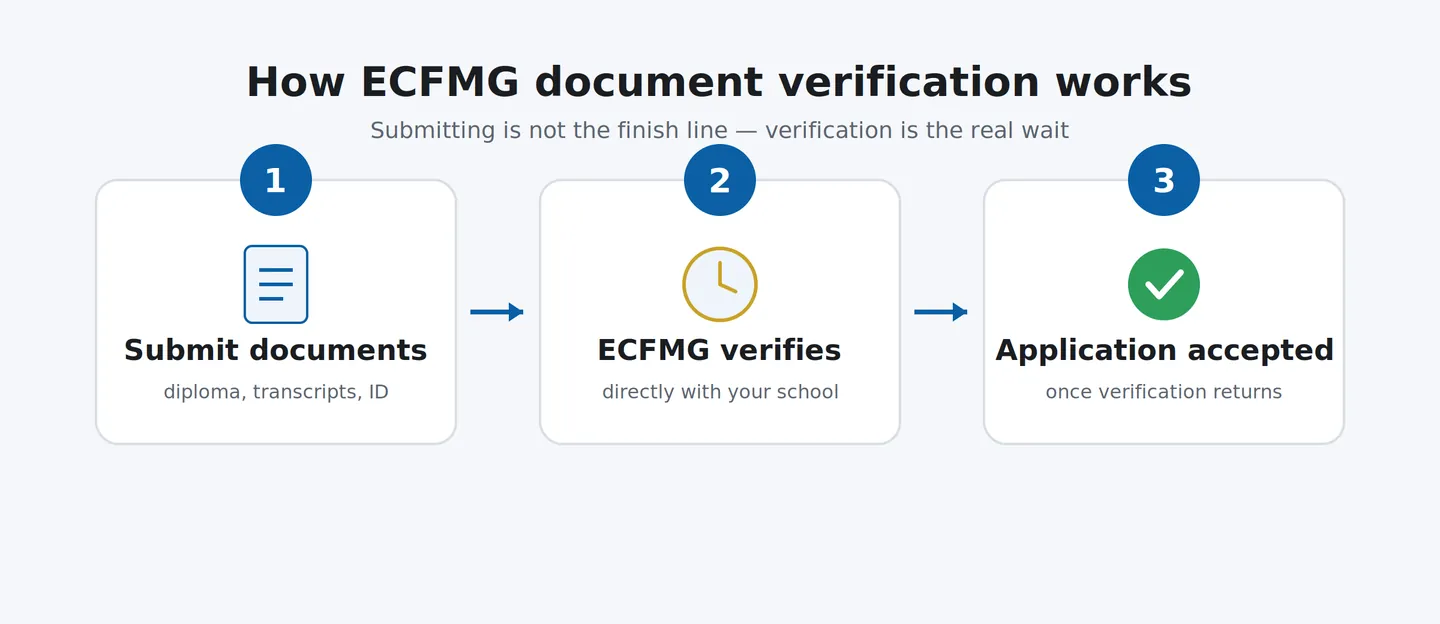
ECFMG sends your medical diploma directly to your medical school and confirms, with the officials there, that it's genuine. Your application isn't fully accepted until that primary-source verification comes back and is accepted. You don't control this step. Your school does, and some schools are slow.
This is exactly why "prepare your documents early" isn't just tidy advice. The verification clock only starts once you've submitted, and if your school takes months to respond, that's months added to your timeline, often at the worst possible moment relative to residency application deadlines. If there's one section of this guide to take to heart, it's this one. Start early, and stay polite but persistent with your registrar.
A quick word on what registration does not require
It's just as useful to know what you don't need yet, so you don't chase the wrong things.
You don't need to have passed the USMLE to open your account and begin your application. Exams and credentials run on separate tracks. That said, ECFMG Certification as a whole does require passing USMLE Step 1 and Step 2 CK, so if you're mapping the bigger picture, our USMLE Step 1 guide is a good next read. You also don't need a US visa, a job offer, or letters of recommendation at this stage. Registration is about confirming who you are and where you trained, nothing more.
Common mistakes that cost people weeks
Assuming "graduated" means "diploma in hand." If your diploma is delayed, use the authorised official's letter with the exact required wording. Don't wait months for the physical document when you don't have to.
A passport that's about to expire. Your details are matched to a current, unexpired passport. If yours expires soon, renew it before you start, or you'll be redoing steps.
Leaving translations to the end. Official translations take time. Line them up alongside your other documents, not after.
Treating submission as the last step. Verification with your school is the real bottleneck. The earlier you submit, the earlier that clock starts.
Not checking the World Directory first. If your school's listing or Sponsor Note doesn't cover your graduation year, sort that out before anything else.
Frequently asked questions
What documents do I need for ECFMG registration?
At minimum: your current passport (your details must match it exactly), your final medical diploma, and transcripts documenting any transferred credits. Your final medical school transcript is also required, but ECFMG usually requests that from your school directly during verification. Any non-English document needs an official English translation.
Do I need my diploma before I can register?
No. You can begin as a student, or as a graduate whose diploma hasn't been issued yet. In the latter case you submit a letter from an authorised school official with ECFMG's exact required wording, then send the diploma once it's issued.
Does my transcript need to be translated?
Yes, if it isn't in English. Both your diploma and transcripts need an official English translation that meets ECFMG's standards. A self-translation won't be accepted.
Why does the portal say MyIntealth instead of ECFMG?
ECFMG is now a division of Intealth, and its online portal is called MyIntealth. Your ID is your MyIntealth Identification Number. The ECFMG Certification itself hasn't changed.
How long does document verification take?
It varies, because it depends on how quickly your medical school responds to ECFMG's request. This is often the longest part of the process, which is why submitting early matters so much.
Do I need to pass the USMLE before submitting my documents?
No. You can open your account and start your application without any USMLE results. Passing Step 1 and Step 2 CK is required for full ECFMG Certification, but it runs separately from your credential documents.
What if my name on my diploma differs from my passport?
This happens often, and ECFMG has procedures for it. Your record is matched to your passport, and there are specific rules for names on diplomas and transcripts. Follow the instructions provided during your application, and keep any supporting documents (such as a marriage certificate or affidavit) ready.
Key takeaways
- Your passport comes first: your name, date of birth, and gender must match it exactly
- Check that your school is in the World Directory with an ECFMG Sponsor Note covering your graduation year
- Core credentials are your final medical diploma and transcripts for any transferred credits
- If your diploma isn't issued yet, use an authorised official's letter with ECFMG's exact wording
- Any non-English document needs an official English translation
- Verification with your school is the real bottleneck, so submit early
- The portal is now MyIntealth, though the ECFMG Certification is unchanged
Getting organised is the easy win
You can't control how fast your school verifies your diploma, and you can't control the residency timeline. But you can control whether your documents are ready and correct on day one. That single piece of preparation is what separates the applicants who move smoothly through registration from the ones who spend a season chasing paperwork.
For the wider picture of the credentialing journey, see our ECFMG certification guide. And if you're weighing the whole move abroad, our guide to the documents you need before relocating as an IMG covers what sits around this step.
Get your folder in order now, and future-you will be grateful.
Ready to get organised? Download the free ECFMG document checklist (Google Doc) and join the Sentia Telegram community for step-by-step guidance, shared resources, and support from fellow International Medical Graduates walking the same path. → Click