
NAC OSCE Guide (2026): Pass Canada's Clinical Exam
The complete NAC OSCE Guide (2026): Pass Canada's Clinical Exam covers station format, scoring, CaRMS timing, and how to prepare.

This NAC OSCE Guide (2026) walks IMGs through exactly how to pass Canada's clinical exam, how it's structured, how it's scored, and how to walk in prepared.
If you're an international medical graduate planning to practise in Canada, you've probably already heard the three letters that make most IMGs nervous: NAC. The NAC OSCE is formally called the National Assessment Collaboration Examination. It's the clinical skills test that stands between you and a spot in the CaRMS residency match. Consider this your NAC OSCE Guide (2026): Pass Canada's Clinical Exam: a full walkthrough of the format, the scoring, and what it actually takes to get through it. It's a half-day series of simulated patient encounters, and unlike a written exam, there's no multiple-choice safety net. You either show the examiner you can think and communicate like a resident, or you don't.
This guide walks through exactly what the NAC OSCE involves. It covers who has to take it, how it's scored, and what actually moves the needle when you're preparing. However, we'll keep the theory to a minimum and focus on what you need to know before exam day.
What Is the NAC OSCE?
This section of the NAC OSCE guide covers the basics before we get into format and scoring. The NAC examination is run by the Medical Council of Canada (MCC), the same body responsible for the MCCQE. It was created to give residency programmes across the country a single, standardised way to compare candidates trained outside Canada. This replaced a patchwork of provincial assessments that made comparisons difficult.
In practice, the NAC OSCE is a half-day Objective Structured Clinical Examination held twice a year, in spring and fall, at designated centres across Canada. You rotate through a series of short stations, each built around a clinical scenario. For example, a patient with chest pain, a mother worried about her child's fever, or a person who needs counselling on smoking cessation. At each station, you're given a brief written prompt telling you what's expected. It might ask you to take a history, perform part of a physical exam, explain a diagnosis, or counsel the patient on next steps.
It sounds simple on paper. In the room, with a real clock running and a standardised participant (SP) playing the patient, it feels a lot more demanding.
Who Needs to Take the NAC OSCE?
Not everyone applying to Canadian residency writes this exam. However, the group required to take it is broader than many candidates assume. According to the MCC, you're eligible if you are a graduate of or a student close to completing your degree at any of the following:
- A medical school outside Canada listed in the World Directory of Medical Schools with a Canada Sponsor Note
- A U.S. school of osteopathic medicine
- A U.S. school of allopathic medicine, but only if you graduated on or after 1 July 2025
Worth knowing: Canadian citizens who studied medicine abroad are still classified as IMGs for this purpose. Where you trained matters more than your citizenship, and as of July 2025, U.S. MD graduates who previously bypassed the NAC now need it too, a significant shift for anyone who assumed a U.S. degree would exempt them.
If you're weighing whether Canada is even the right pathway for you, it helps to zoom out first. Additionally, if you're specifically comparing routes into Canadian practice from Nigeria, our piece on how Nigerian doctors relocate to Canada covers some of the country-specific groundwork.
NAC OSCE Format: Stations, Timing, and Structure
This is the part of the NAC OSCE Guide most candidates bookmark. The exam has a fixed rhythm, and knowing it cold takes a lot of the anxiety out of exam day.
| Element | Detail |
|---|---|
| Total stations | 12 (10 scored, 2 unscored pilot stations) |
| Time per station | 11 minutes |
| Break between stations | 2 minutes |
| Rest stations | 2-3 built in, with no clinical task or score |
| Format | Single half-day session; all candidates rotate through the same stations |
| Languages | English or French, at designated exam centres |
You won't know which two stations are pilot stations, and they don't count toward your score. As a result, the only sensible approach is to treat every single station as if it's being marked; for all you know, it is.
Each station opens with a short written statement outside the door. You'll get a moment to read it before you go in. It tells you exactly what's being asked of you: take a focused history, perform a specific exam, counsel the patient, or interpret a result. Inside, there's typically a standardised participant playing the patient and a physician examiner (PE) quietly observing and scoring in the background.
What the stations actually test
Content is drawn from six broad clinical areas: medicine, surgery, paediatrics, obstetrics and gynaecology, psychiatry, and preventive medicine and public health. Within each station, an examiner can assess you across up to seven competencies:
- History taking: gathering a logical, efficient account of the patient's problem
- Physical examination: performing findings in a sensible sequence, respectful of patient comfort
- Diagnosis: separating relevant from irrelevant information to reach a sound differential
- Investigations: choosing appropriate tests, weighing risk and benefit
- Data interpretation: reading results correctly in context
- Management: proposing treatment, counselling, and follow-up appropriately
- Communication skills: patient-centred language, active listening, and clear explanation
Not every station tests all seven. A counselling station might lean heavily on communication and management; a data station might focus on interpretation and diagnosis. Reading the stem carefully tells you where the marks are likely concentrated.
How the NAC OSCE Is Scored
This is the part candidates ask about most, and it's worth understanding properly rather than relying on rumours on forums.
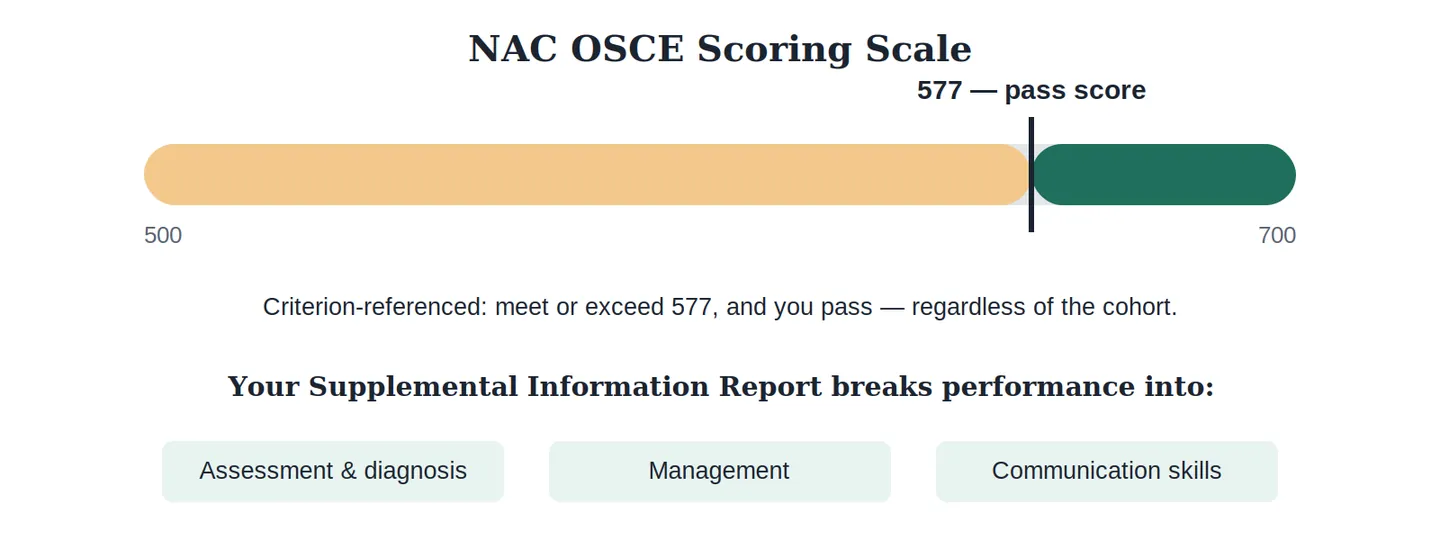
Your total score is reported on a scale of 500 to 700, and the current pass score set in May 2023 is 577. Your result is calculated from your average performance across the 10 scored stations, since the pilot stations are excluded. This is then adjusted through a statistical process the MCC calls "linking", which accounts for differences in difficulty between exam sessions.
Crucially, the NAC OSCE is criterion-referenced, not curved. That means you're being measured against a fixed performance standard, not ranked against everyone else in the room. If you meet or exceed 577, you pass, full stop, regardless of how strong or weak that day's cohort happens to be.
About eight weeks after the exam session ends, you'll receive two documents in your physiciansapply.ca account. The first is a statement of results showing your pass/fail outcome and total score. The second is a supplemental information report breaking your performance down into three broader domains: assessment and diagnosis, management, and communication skills. That second document is genuinely useful if you don't pass the first time, since it tells you where to focus rather than leaving you guessing.
NAC OSCE Timing With CaRMS
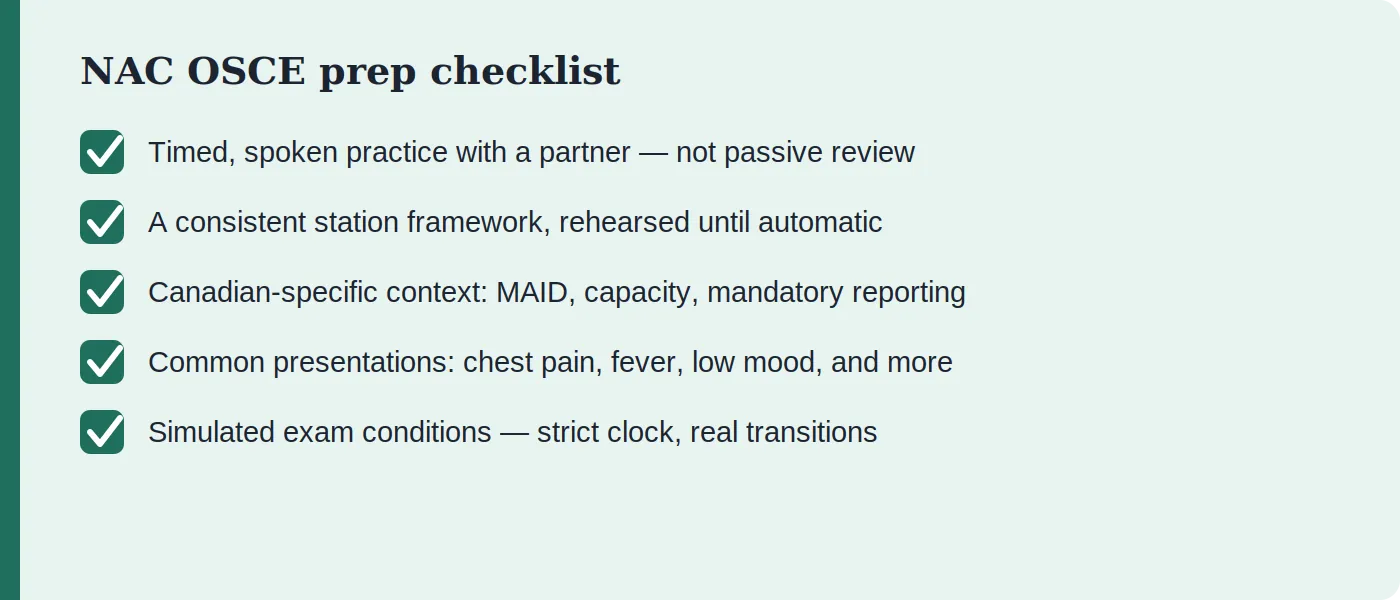
If you're planning your IMG timeline, this is where a lot of confusion happens. To apply to the CaRMS R-1 Main Residency Match as an IMG, you need results for both the MCCQE Part I and the NAC examination. The MCC doesn't require you to take them in a particular order. Instead, you can sit the NAC before or after the MCCQE, whichever fits your study plan better.
What matters is the calendar. The NAC is offered twice yearly, spring and fall, and results take roughly eight weeks to come back. If you're targeting a specific CaRMS cycle, work backwards from the application deadline. Make sure your NAC results will actually be available in time, not just that you've booked a seat. Many IMGs get this backward and end up with a passing score that arrives a few weeks too late for the match they wanted.
How Many Times Can You Take the NAC OSCE?
You're allowed a maximum of three attempts, regardless of whether earlier attempts were passes or fails. Only your most recent result counts, and it doesn't expire; there's no time limit on how long ago you sat it. One restriction to note: you can't retake the exam in the session immediately following your last one. If you wrote it in May, your next opportunity is the following May at the earliest, not the fall session right after.
That gap matters for planning. A failed attempt in spring doesn't mean you lose a full year automatically. However, it does mean roughly six months of runway to work on the specific gaps your Supplemental Information Report flagged.
Common Challenges IMGs Face
This part of the NAC OSCE Guide is worth reading closely. A few patterns show up again and again among candidates who struggle, and most of them have nothing to do with medical knowledge.
Bringing a foreign OSCE habit into a Canadian station. If you trained for PLAB 2, the AMC clinical exam, or another country's licensing OSCE, your instincts might be technically sound but stylistically off. Canadian stations reward an explicit, patient-centred communication exam, narrating style: narrating what you're doing and why, checking understanding, and using plain language rather than clinical shorthand.
Running out of structure, not out of knowledge. Eleven minutes disappear fast. Candidates who wander into a station without a repeatable framework often run out of time before they've demonstrated what they actually know. A reliable framework looks like a greeting, an open-ended question, a focused history or exam, a management discussion, safety netting, and a closing.
Underestimating the communication and safety-netting components. It's common to nail the clinical reasoning and still lose marks because the closing wasn't clear. Often there's no summary, no plan for follow-up, and no mention of when the patient should seek urgent care.
Treating it like a knowledge test. The NAC checks whether your clinical approach translates into the Canadian context, not just whether you know the right answer. Two candidates can reach the same diagnosis and score very differently based on how they got there.
How to Prepare for the NAC OSCE
This is the section of the NAC OSCE Guide most people are here for. Preparation for this exam looks different from preparing for a written test, and the sooner candidates accept that, the better their results tend to be.
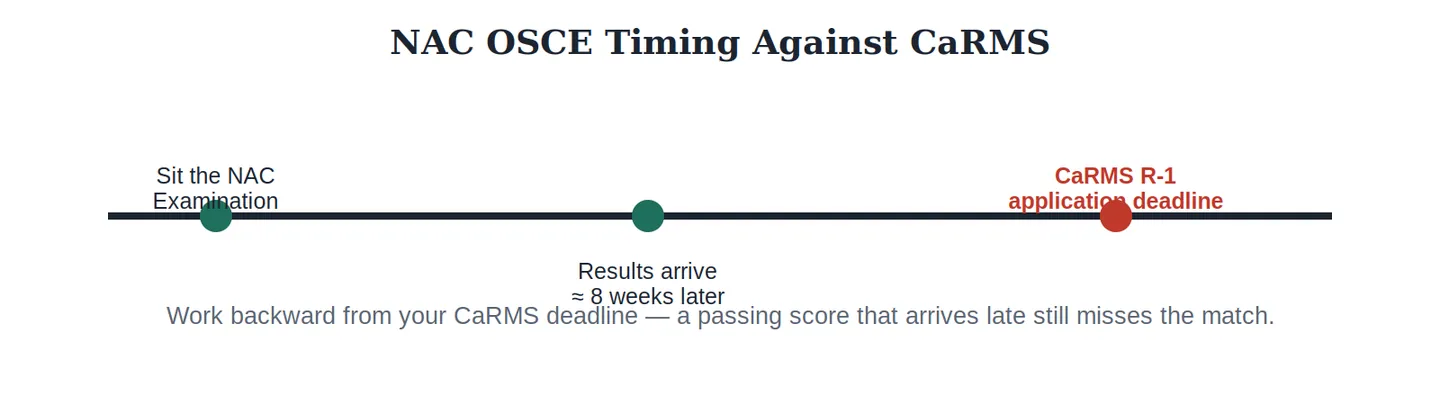
Practise out loud, with another person. You cannot meaningfully prepare for an OSCE by reading alone. Find a study partner, join a peer group, or work with a structured prep programme. The goal is repeated, timed, spoken practice, not passive review.
Use a consistent station framework. Whatever structure you settle on, greeting, opening question, focused assessment, management, safety netting, or close, rehearse it until it's automatic. Under time pressure, structure is what keeps you from freezing.
Study Canadian-specific context. Topics like medical assistance in dying (MAID), capacity assessment, and mandatory reporting obligations show up regularly. The Canadian immunisation schedule is another one, and these are often unfamiliar to candidates trained elsewhere.
Cover the common presentations. Chest pain, abdominal pain, headache, shortness of breath, low mood, a prenatal visit, and a febrile child are common examples. These recur because they're common in real practice, not because the exam is trying to trick you.
Simulate exam conditions, not just content. Time yourself. Practise the two-minute transition between stations. Get comfortable with the discomfort of a strict clock: that's often what separates a strong performance from a rushed one.
Common Misconceptions About the NAC OSCE
The rest of this NAC OSCE Guide wouldn't be complete without clearing up a few myths that circulate among candidates.
"My accent will hurt my score." Accent alone isn't penalised. What matters is clarity, structure, and whether the patient understands you, not how you sound.
"It's basically the same as PLAB 2 or the AMC exam." The clinical skills transfer, but the expected communication style and context don't automatically. Canadian stations have their own conventions worth learning deliberately.
"A pass is a pass: the score doesn't matter beyond that." This is technically true for eligibility. That said, some residency programs consider NAC scores as part of a broader application review. A score comfortably above the pass mark is a stronger signal than one that barely clears it.
"I only need to worry about this after my MCCQE." There's no required order. Many IMGs benefit from planning both exams around their CaRMS deadline rather than assuming one has to come first.
Frequently Asked Questions
To close out this NAC OSCE Guide, here are quick answers to the questions IMGs ask most.
What does NAC OSCE stand for?
NAC stands for National Assessment Collaboration, and OSCE stands for Objective Structured Clinical Examination. Together, the NAC OSCE is a national clinical skills exam for IMGs seeking entry into Canadian residency training.
Is the NAC OSCE mandatory for all IMGs applying to CaRMS?
Yes. IMGs, along with U.S. osteopathic graduates and U.S. allopathic graduates who finished on or after July 1, 2025, must submit both MCCQE Part I and NAC Examination results. This is required to apply to the CaRMS R-1 Main Residency Match.
How many stations are on the NAC OSCE?
Twelve stations in total: ten scored stations and two unscored pilot stations, plus two or three unscored rest stations built into the rotation.
What is the NAC OSCE pass score?
The pass score is 577 on a 500-700 scale, set by the MCC in May 2023. Your total score is based on your average across the ten scored stations.
How long does it take to get NAC OSCE results?
Results are typically available about eight weeks after the last day of the exam session, delivered through your physiciansapply.ca account.
How many times can I take the NAC OSCE?
A maximum of three attempts. Only your most recent result is valid; it doesn't expire, and you can't sit the exam in two consecutive sessions.
Do I need to take the NAC OSCE before the MCCQE Part I?
No. The MCC allows candidates to take the NAC Examination and MCCQE Part I in either order. The only requirement is that both results be ready by your CaRMS application deadline.
Does the NAC OSCE test medical knowledge or communication skills?
Both. Each station can assess up to seven competencies, including history taking, physical examination, diagnosis, investigations, data interpretation, management, and communication skills.
Key Takeaways
Here's the short version of this NAC OSCE Guide (2026): Pass Canada's Clinical Exam if you're skimming before your next study session:
- The NAC OSCE is a half-day, 12-station clinical exam required for most IMGs applying to CaRMS, run twice yearly by the Medical Council of Canada.
- Each of the 10 scored stations runs for 11 minutes, testing up to seven competencies across history taking, examination, diagnosis, management, and communication.
- The pass score is 577 on a 500-700 scale, and results arrive roughly eight weeks after the exam.
- You get three attempts, can't sit in an exam if consecutive sessions, and only your latest result counts.
- Strong preparation means timed, spoken practice with a consistent station structure, not just reading about clinical scenarios.
Final Thoughts
The NAC OSCE rewards candidates who treat it as a skills exam rather than a knowledge test. You can know every guideline in the textbook and still lose marks if your history-taking wanders. The same is true if your closing leaves the patient without a clear plan. The good news is that structure and communication are trainable. In fact, they're arguably more trainable than raw medical knowledge, since they respond so directly to repeated, timed practice.
Give yourself real runway before your session, and work with people who can give you honest feedback. Treat every station stem as instructions worth reading twice. That combination is what turns a stressful half-day into a manageable one, and it's the core of what this NAC OSCE Guide (2026) has tried to set you up for.
Preparing for the NAC OSCE doesn't have to be a solo effort. Find NAC OSCE study partners in the Sentia Telegram community and connect with fellow IMGs working through the same stations, timelines, and CaRMS decisions.